

KLI Colloquia are invited research talks of about an hour followed by 30 min discussion. The talks are held in English, open to the public, and offered in hybrid format.
Join via Zoom:
https://us02web.zoom.us/j/5881861923?omn=85945744831
Meeting ID: 588 186 1923
Fall-Winter 2026/27 KLI Colloquium Series
1 October 2026 (Thurs) 3-4:30 PM CET 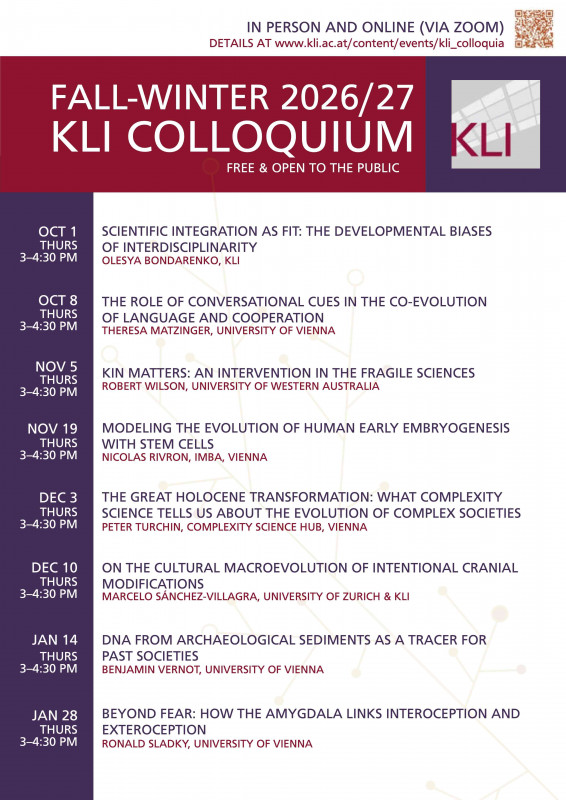
Scientific Integration as Fit: The Developmental Biases of Interdisciplinarity
Olesya BONDARENKO (KLI)
8 October 2026 (Thurs) 3-4:30 PM CET
The Role of Conversational Cues in the Co-Evolution of Language and Cooperation
Theresa MATZINGER (University of Vienna)
5 November 2026 (Thurs) 3-4:30 PM CET
Kin Matters: An Intervention in the Fragile Sciences
Robert A. WILSON (University of Western Australia)
19 November 2026 (Thurs) 3-4:30 PM CET
Modeling the Evolution of Human Early Embryogenesis with Stem Cells
Nicolas RIVRON (Institute of Molecular Biotechnology/IMBA, Vienna)
3 December 2026 (Thurs) 3-4:30 PM CET
Peter TURCHIN (Complexity Science Hub, Vienna)
10 December 2026 (Thurs) 3-4:30 PM CET
On the Cultural Macroevolution of Intentional Cranial Modifications
Marcelo SÁNCHEZ-VILLAGRA (University of Zurich)
14 January 2027 (Thurs) 3-4:30 PM CET
DNA from Archaeological Sediments as a Tracer for Past Societies
Benjamin VERNOT (University of Vienna)
28 January 2027 (Thurs) 3-4:30 PM CET
Beyond Fear: How the Amygdala Links Interoception and Exteroception
Ronald SLADKY (University of Vienna)
KLI Colloquia 2014 – 2026
Event Details
Topic description / abstract:
In my talk I will firstly explain what it means to think of humans as "geological agents" in the Anthropocene. The Anthropocene challenges the academic separation between the natural sciences on the one hand, and the social sciences and the humanities on the other. The talk will explain the need for inter-/transdisciplinary dialogue and the role of the Vienna Anthropocene Network at Vienna University. In the second part of my presentation, I will then elaborate on some of the debates about thinking the human in the Anthropocene. Can we even address „humanity“ as an undifferentiated whole? Should we not rather talk about life-styles, forms of consumerism, and late-capitalist economies as the sources of the Anthropocene crisis - instead of referring to the „human species“? On the other hand, we also need to ask what makes humans specific in comparison to other species. What abilitities (or inabilities) have made homo sapiens the present dominant species? And is it sufficient to understand the Anthropocene as a result of human impact or should we rather think it as the product of certain technologies?
Biographical note:
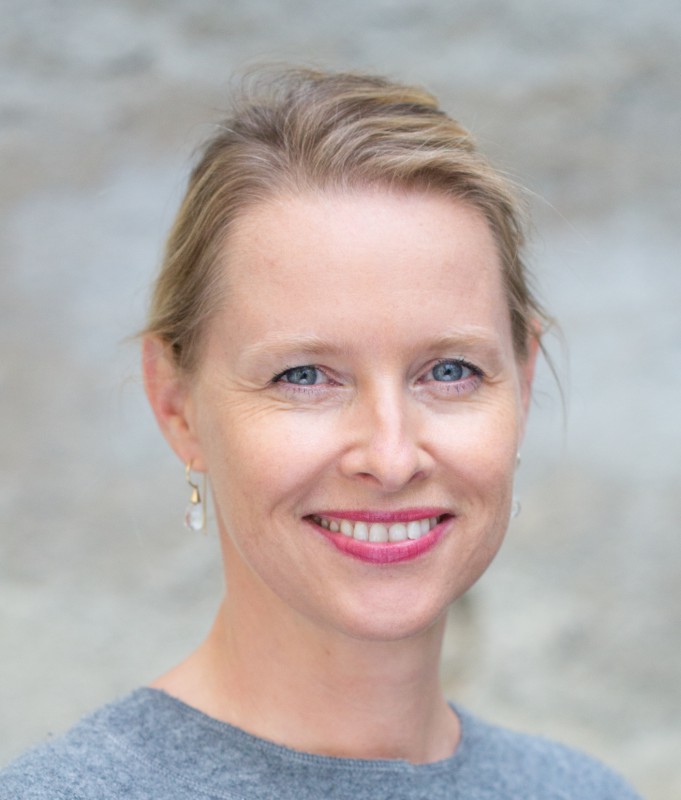
Eva Horn is professor of Modern German literature and cultural history at the University of Vienna. She has taught in Germany, Switzerland, the US, France, and Austria. Her research revolves around the interactions of fiction, scientific knowledge and political thought. After her PhD on German Romanticism, she published a book about political secrecy in the 20th century, The Secret War: Treason, Espionage, and Modern Fiction. In recent years her research has focused on the ways in which the future, and more specifically, catastrophic futures are addressed in literature and film. Her book The Future as Catastrophe: Disaster Imagination in the Modern Age assesses the history of disaster scenarios in fiction, politics and science, from nuclear apocalypse to the visions of climate change since the 18th century. Currently she is finishing an introduction to the concept of the Anthropocene for the humanities, together with Prof. Hannes Bergthaller (Taichung) (forthcoming in German and English in fall 2019). From 2014-2018, she directed Climate’s Time, a research project on literary conceptions of climate from the 18th century to the present and its inherent temporalizations of nature. She was a visiting professor at the German Departments of NYU and Columbia University, and has been a Fellow at the Kulturwissenschafliches Kolleg at Universität Konstanz (2008) and the Institute of Advanced Sustainability Studies, Potsdam (2016). She is currently the founder and director of the Vienna Anthropocene Network.
