

KLI Colloquia are invited research talks of about an hour followed by 30 min discussion. The talks are held in English, open to the public, and offered in hybrid format.
Join via Zoom:
https://us02web.zoom.us/j/5881861923?omn=85945744831
Meeting ID: 588 186 1923
Fall-Winter 2026/27 KLI Colloquium Series
1 October 2026 (Thurs) 3-4:30 PM CET 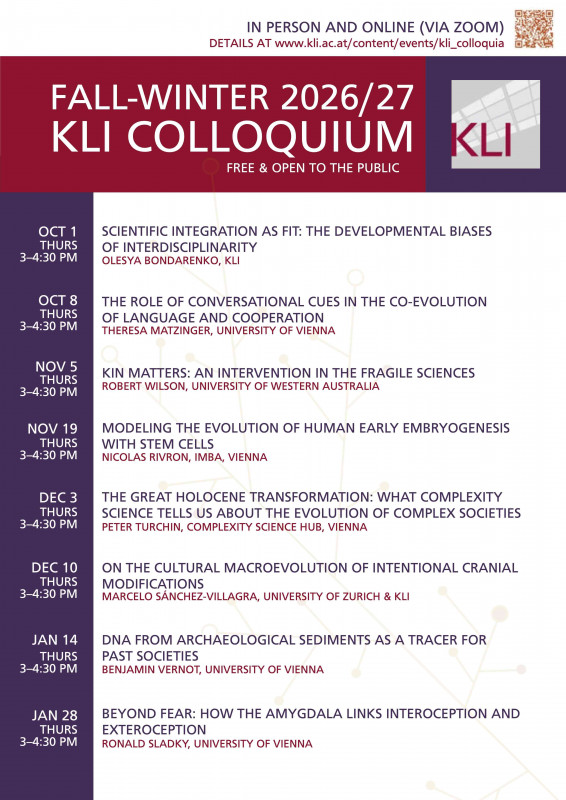
Scientific Integration as Fit: The Developmental Biases of Interdisciplinarity
Olesya BONDARENKO (KLI)
8 October 2026 (Thurs) 3-4:30 PM CET
The Role of Conversational Cues in the Co-Evolution of Language and Cooperation
Theresa MATZINGER (University of Vienna)
5 November 2026 (Thurs) 3-4:30 PM CET
Kin Matters: An Intervention in the Fragile Sciences
Robert A. WILSON (University of Western Australia)
19 November 2026 (Thurs) 3-4:30 PM CET
Modeling the Evolution of Human Early Embryogenesis with Stem Cells
Nicolas RIVRON (Institute of Molecular Biotechnology/IMBA, Vienna)
3 December 2026 (Thurs) 3-4:30 PM CET
Peter TURCHIN (Complexity Science Hub, Vienna)
10 December 2026 (Thurs) 3-4:30 PM CET
On the Cultural Macroevolution of Intentional Cranial Modifications
Marcelo SÁNCHEZ-VILLAGRA (University of Zurich)
14 January 2027 (Thurs) 3-4:30 PM CET
DNA from Archaeological Sediments as a Tracer for Past Societies
Benjamin VERNOT (University of Vienna)
28 January 2027 (Thurs) 3-4:30 PM CET
Beyond Fear: How the Amygdala Links Interoception and Exteroception
Ronald SLADKY (University of Vienna)
KLI Colloquia 2014 – 2026
Event Details

Topic description / abstract:
Childbirth in humans is difficult compared to most other mammals. There is a high risk of mortality and morbidity to both mother and baby associated with childbirth arising from the tight fit or mismatch between the size of the baby and the maternal birth canal. So why has the human birth canal not evolved to be wider? This 'obstetric conundrum' has long been debated and several explanations have been advanced. However, explanatory factors are manifold, interact, vary among human populations, and often pertain to different levels of explanation, impeding our understanding of this conundrum and attempts to resolve it. To help overcome this challenge, a theoretical framework is required, grounded in evolutionary theory and integrating principles from developmental and evolutionary biology, which helps to reconcile different levels of explanation and identify methodological challenges and outstanding questions pertaining to the obstetric conundrum.
Furthermore, few evolutionary hypotheses of why the human pelvis evolved to be relatively narrow exist, and the ones that do have received little empirical attention. One in particular, the pelvic floor hypothesis, will be the focus of applied research. Using numerical finite element simulations, the pelvic floor will be modeled as an idealized membrane and subjected to sensitivity analysis to establish the relationship between membrane geometry and its level of deformation. Lastly, not only pelvic size and shape are relevant for childbirth; the degree of mobility at the pelvic joints can also facilitate or hinder easy passage of the fetus through the birth canal. Mammals document a range of pubic symphysis morphologies, reflecting a combination of adaptations and constraints related to positional behavior, birth, and phylogeny, the study of which can yield valuable insight into the human condition.
Biographical note:
Nicole Grunstra is a biological anthropologist, interested in the interaction between evolutionary processes (both adaptive and neutral), evolutionary constraints, and variational properties in giving rise to macroevolutionary patterns of trait evolution. Nicole first used such a 'holistic' approach in her doctoral dissertation on phenotypic diversification in macaques (Primates: Macaca) at the University of Cambridge (UK). To this end, she studied phenotype-environment associations using traditional morphometrics, multivariate statistics, and phylogenetic comparative methods. She has since added the use of geometric morphometrics and other digitization techniques to her repertoire. Her main theoretical interest concerns the definition, usage and detection of phylogenetic 'constraints', phylogenetic 'effects', and phylogenetic signal.
Nicole's current projects include the decomposition of primate cranial shape into components that differentially preserve phylogenetic history, adaptation, and ontogenetic trajectories, as well as a comparative study of pelvic morphology in relation to neonatal size in bats (Chiroptera). Her proposed research at the KLI is devoted to the study of the human and non-human mammalian pelvis in pursuit of resolving the 'obstetric conundrum' of why the human birth canal evolved to be narrow relative to the size of our neonates, with a special focus on the pelvic floor hypothesis.
