

KLI Colloquia are invited research talks of about an hour followed by 30 min discussion. The talks are held in English, open to the public, and offered in hybrid format.
Join via Zoom:
https://us02web.zoom.us/j/5881861923?omn=85945744831
Meeting ID: 588 186 1923
Fall-Winter 2026/27 KLI Colloquium Series
1 October 2026 (Thurs) 3-4:30 PM CET 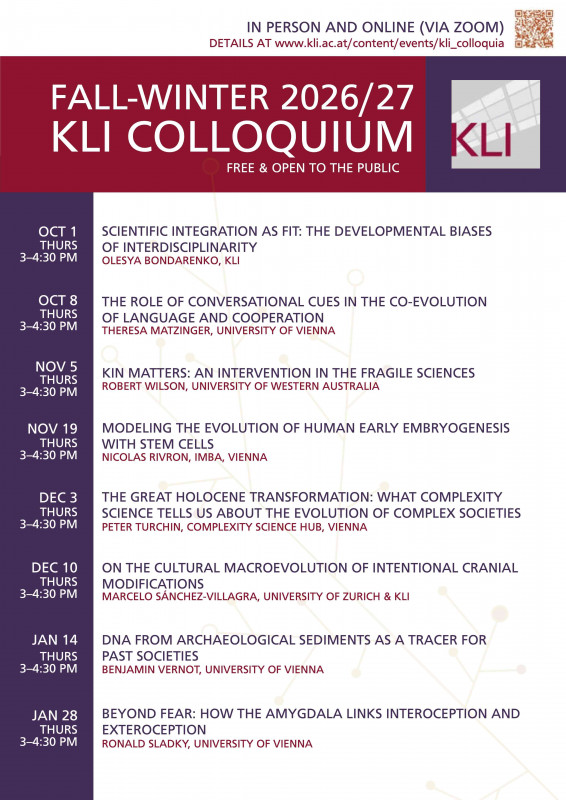
Scientific Integration as Fit: The Developmental Biases of Interdisciplinarity
Olesya BONDARENKO (KLI)
8 October 2026 (Thurs) 3-4:30 PM CET
The Role of Conversational Cues in the Co-Evolution of Language and Cooperation
Theresa MATZINGER (University of Vienna)
5 November 2026 (Thurs) 3-4:30 PM CET
Kin Matters: An Intervention in the Fragile Sciences
Robert A. WILSON (University of Western Australia)
19 November 2026 (Thurs) 3-4:30 PM CET
Modeling the Evolution of Human Early Embryogenesis with Stem Cells
Nicolas RIVRON (Institute of Molecular Biotechnology/IMBA, Vienna)
3 December 2026 (Thurs) 3-4:30 PM CET
Peter TURCHIN (Complexity Science Hub, Vienna)
10 December 2026 (Thurs) 3-4:30 PM CET
On the Cultural Macroevolution of Intentional Cranial Modifications
Marcelo SÁNCHEZ-VILLAGRA (University of Zurich)
14 January 2027 (Thurs) 3-4:30 PM CET
DNA from Archaeological Sediments as a Tracer for Past Societies
Benjamin VERNOT (University of Vienna)
28 January 2027 (Thurs) 3-4:30 PM CET
Beyond Fear: How the Amygdala Links Interoception and Exteroception
Ronald SLADKY (University of Vienna)
KLI Colloquia 2014 – 2026
Event Details
Topic description / abstract:
The Anthropocene, and the complex systems of entanglement and feedback that define it, present a new representational challenge: How to both sense, and “make sense” of, the immanent and pervasive nature of planetary change. The niches that we’ve constructed for ourselves can reveal – but just as often obfuscate – the multispecies ecologies at work, and the strange trajectories in which they are evolving. This talk will look at these forms of dissonance as a question of “system aesthetics” and of umwelten that concern the dynamics of perception, its constraints, and the cycles of feedback and causality that they entangle.
Biographical note:
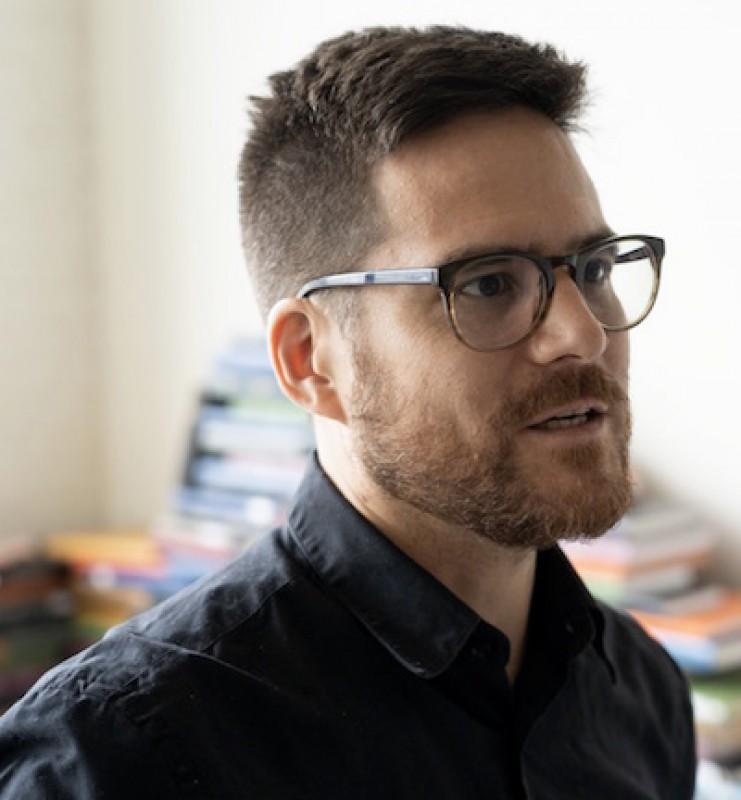
Andrew S. Yang is a transdisciplinary artist working across the flux of the naturalcultural. His projects have been exhibited from Oklahoma to Yokohama, including the 14th Istanbul Biennial (2015), a solo exhibition at the MCA Chicago (2016), the Spencer Museum of Art (2019), and the Smithsonian Museum of Natural History (2020). His writings appear in Leonardo, Biological Theory, Art Journal, Evolution & Development and the forthcoming Routledge Handbook of Art, Science, and Technology Studies. He will be the inaugural artist-in-residence at Yale-NUS College in Singapore in the spring of 2020. He holds a PhD in evolutionary biology from Duke University and MFA in visual arts from Lesley University School of Art and Design, and is Associate Professor at the School of the Art Institute of Chicago.
