

KLI Colloquia are invited research talks of about an hour followed by 30 min discussion. The talks are held in English, open to the public, and offered in hybrid format.
Join via Zoom:
https://us02web.zoom.us/j/5881861923?omn=85945744831
Meeting ID: 588 186 1923
Fall-Winter 2026/27 KLI Colloquium Series
1 October 2026 (Thurs) 3-4:30 PM CET 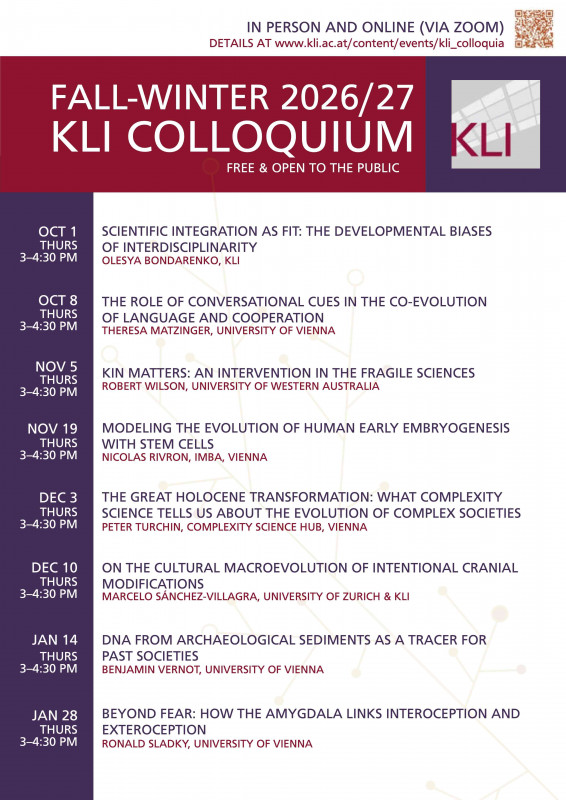
Scientific Integration as Fit: The Developmental Biases of Interdisciplinarity
Olesya BONDARENKO (KLI)
8 October 2026 (Thurs) 3-4:30 PM CET
The Role of Conversational Cues in the Co-Evolution of Language and Cooperation
Theresa MATZINGER (University of Vienna)
5 November 2026 (Thurs) 3-4:30 PM CET
Kin Matters: An Intervention in the Fragile Sciences
Robert A. WILSON (University of Western Australia)
19 November 2026 (Thurs) 3-4:30 PM CET
Modeling the Evolution of Human Early Embryogenesis with Stem Cells
Nicolas RIVRON (Institute of Molecular Biotechnology/IMBA, Vienna)
3 December 2026 (Thurs) 3-4:30 PM CET
Peter TURCHIN (Complexity Science Hub, Vienna)
10 December 2026 (Thurs) 3-4:30 PM CET
On the Cultural Macroevolution of Intentional Cranial Modifications
Marcelo SÁNCHEZ-VILLAGRA (University of Zurich)
14 January 2027 (Thurs) 3-4:30 PM CET
DNA from Archaeological Sediments as a Tracer for Past Societies
Benjamin VERNOT (University of Vienna)
28 January 2027 (Thurs) 3-4:30 PM CET
Beyond Fear: How the Amygdala Links Interoception and Exteroception
Ronald SLADKY (University of Vienna)
KLI Colloquia 2014 – 2026
Event Details

Join by Zoom:
Topic description / abstract:
In this paper, we argue that in order to understand the interdisciplinary and transdisciplinary dialectics in sustainability science, it is useful to see sustainability science as a kind of operations research/management science (OR/MS), and then to highlight the hard-soft distinction in systems thinking for OR/MS. First we argue that the commonly made natural-social science dichotomy is relatively unimportant and unhelpful. We then outline the differences between soft and hard systems thinking as a more relevant and helpful distinction, mainly as a difference between perspectives in systemic modeling toward models. We also illustrate that the distinction is methodologically useful to advance sustainability science by enabling us (i) to suggest novel ways of using existing theoretical, experimental, and computational resources of the sciences for renewable resource management, and (ii) to disentangle disciplinary disagreements in climate science.
Biosketch
Michiru Nagatsu is an associate professor at the Helsinki Institute of Sustainability Science, and Practical Philosophy, the University of Helsinki. He runs Economics and Philosophy Lab and HELSUS Methodology Lab. His research uses a range of empirical approaches – including experimental philosophy, collaborations with scientists, interviews, integrated history and philosophy of science – to study conceptual and methodological questions in the philosophy of science.
