

KLI Colloquia are invited research talks of about an hour followed by 30 min discussion. The talks are held in English, open to the public, and offered in hybrid format.
Join via Zoom:
https://us02web.zoom.us/j/5881861923?omn=85945744831
Meeting ID: 588 186 1923
Fall-Winter 2026/27 KLI Colloquium Series
1 October 2026 (Thurs) 3-4:30 PM CET 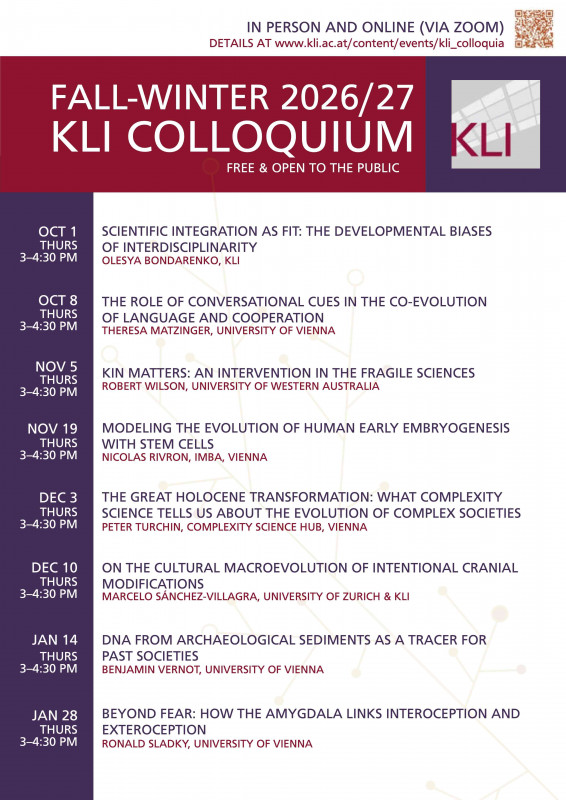
Scientific Integration as Fit: The Developmental Biases of Interdisciplinarity
Olesya BONDARENKO (KLI)
8 October 2026 (Thurs) 3-4:30 PM CET
The Role of Conversational Cues in the Co-Evolution of Language and Cooperation
Theresa MATZINGER (University of Vienna)
5 November 2026 (Thurs) 3-4:30 PM CET
Kin Matters: An Intervention in the Fragile Sciences
Robert A. WILSON (University of Western Australia)
19 November 2026 (Thurs) 3-4:30 PM CET
Modeling the Evolution of Human Early Embryogenesis with Stem Cells
Nicolas RIVRON (Institute of Molecular Biotechnology/IMBA, Vienna)
3 December 2026 (Thurs) 3-4:30 PM CET
Peter TURCHIN (Complexity Science Hub, Vienna)
10 December 2026 (Thurs) 3-4:30 PM CET
On the Cultural Macroevolution of Intentional Cranial Modifications
Marcelo SÁNCHEZ-VILLAGRA (University of Zurich)
14 January 2027 (Thurs) 3-4:30 PM CET
DNA from Archaeological Sediments as a Tracer for Past Societies
Benjamin VERNOT (University of Vienna)
28 January 2027 (Thurs) 3-4:30 PM CET
Beyond Fear: How the Amygdala Links Interoception and Exteroception
Ronald SLADKY (University of Vienna)
KLI Colloquia 2014 – 2026
Event Details

Abstract / topic description:
The species problem seems to be as permanent as it is worrying. From a philosophical point of view, two questions in particular have dominated the discussion – what ontological status species taxa (like Homo sapiens) have (individuals vs natural kinds) and whether species taxa as well as the species category are real or only constructs (realism vs nominalism). Although all of these issues are important to practicing biologists, none is more pressing than the looming spectre of species category nominalism: that what we call species may be incommensurable across the Tree of Life or, even worse, as arbitrary as the higher Linnean categories (families, orders etc.). Comparative biology – as when analyses in macroecology and evolutionary biology, but also in conservation and management, are based on species richness – would be seriously flawed if this were true. In my talk, I will give an overview of these problems, highlighting the consequences for biological research and conservation and briefly hinting at alternative approaches as well as the suggestion of „taxonomic governance“ to mitigate the deleterious impact of competing classifications.
Biographical note:
Frank E. Zachos studied biology, history of science and philosophy and is presently Head of the Mammal Collection at the Natural History Museum Vienna and affiliated professor at the Department of Genetics at the University of the Free State in Bloemfontein, South Africa. His biological research focuses on the intraspecific biodiversity, population genetics, biogeography and conservation of mammals and birds. His main theoretical interests comprise species concepts and the species problem, the foundations of taxonomy and systematics and the history and philosophy of evolutionary biology.
