

KLI Colloquia are invited research talks of about an hour followed by 30 min discussion. The talks are held in English, open to the public, and offered in hybrid format.
Join via Zoom:
https://us02web.zoom.us/j/5881861923?omn=85945744831
Meeting ID: 588 186 1923
Fall-Winter 2026/27 KLI Colloquium Series
1 October 2026 (Thurs) 3-4:30 PM CET 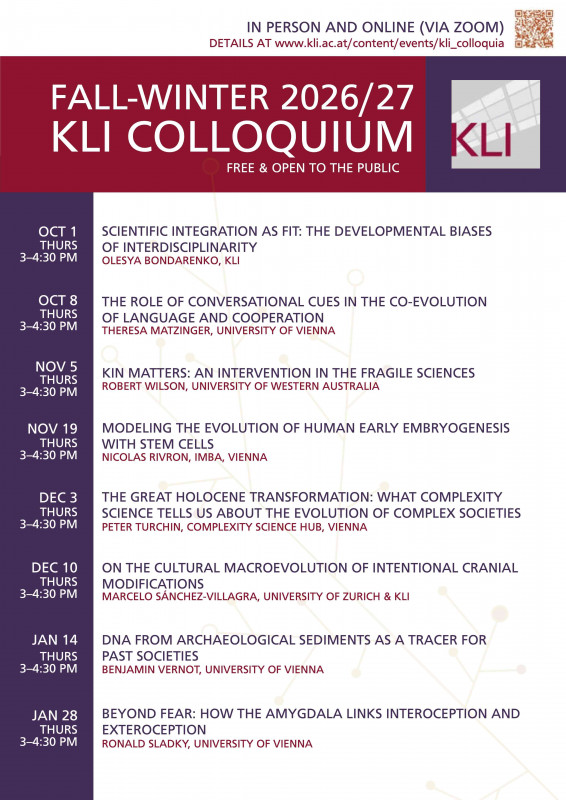
Scientific Integration as Fit: The Developmental Biases of Interdisciplinarity
Olesya BONDARENKO (KLI)
8 October 2026 (Thurs) 3-4:30 PM CET
The Role of Conversational Cues in the Co-Evolution of Language and Cooperation
Theresa MATZINGER (University of Vienna)
5 November 2026 (Thurs) 3-4:30 PM CET
Kin Matters: An Intervention in the Fragile Sciences
Robert A. WILSON (University of Western Australia)
19 November 2026 (Thurs) 3-4:30 PM CET
Modeling the Evolution of Human Early Embryogenesis with Stem Cells
Nicolas RIVRON (Institute of Molecular Biotechnology/IMBA, Vienna)
3 December 2026 (Thurs) 3-4:30 PM CET
Peter TURCHIN (Complexity Science Hub, Vienna)
10 December 2026 (Thurs) 3-4:30 PM CET
On the Cultural Macroevolution of Intentional Cranial Modifications
Marcelo SÁNCHEZ-VILLAGRA (University of Zurich)
14 January 2027 (Thurs) 3-4:30 PM CET
DNA from Archaeological Sediments as a Tracer for Past Societies
Benjamin VERNOT (University of Vienna)
28 January 2027 (Thurs) 3-4:30 PM CET
Beyond Fear: How the Amygdala Links Interoception and Exteroception
Ronald SLADKY (University of Vienna)
KLI Colloquia 2014 – 2026
Event Details
Topic description/ abstract
Immediately following birth, the human body begins to be colonized by microorganisms. This colonization process eventually leads to relatively stable and personalized microbial communities referred to as the human microbiome. Especially in the gut, the establishing microbiome is in contact with the immune system as well as the enteric nervous system, and increasing evidence suggests that during the critical early life period enteric microorganisms participate in bidirectional signaling between the gastrointestinal tract (GIT) and the brain.
While dysbiosis in the gut microbiota has been associated with myriad health conditions, the ecological factors determining the assembly of the gut microbiota in neonates are not fully understood. In this seminar, I will discuss theoretical aspects of microbial community assembly, and will also present clinical data demonstrating how early microbial colonization patterns are associated with later aberrant immune function and impaired neurodevelopment.
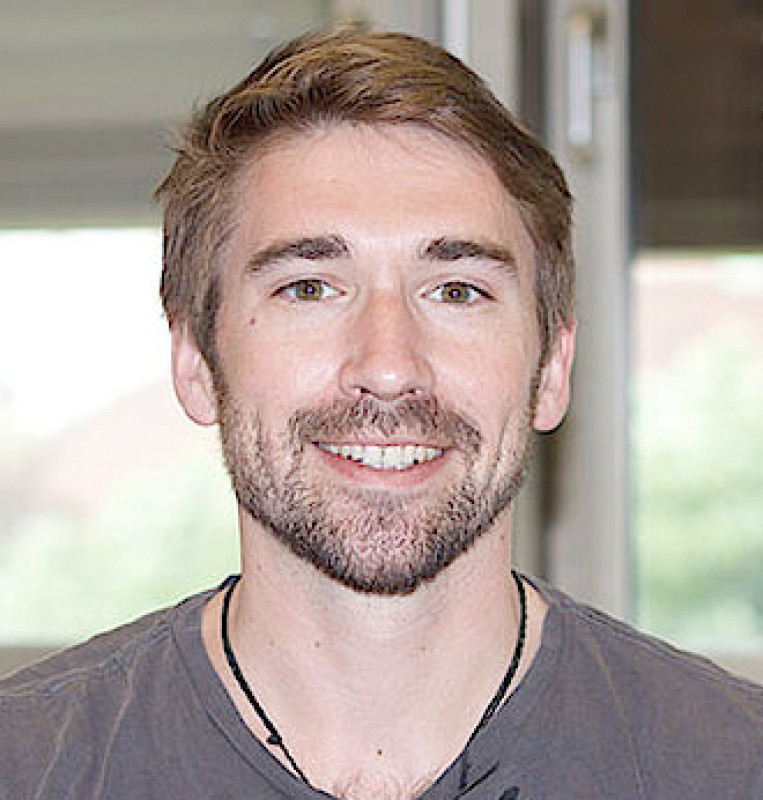
Biographical note
Dr. Berry is full professor and heads a research group focused on the study of the human microbiota and interactions of the microbiota with its host. He has pioneered the use of novel experimental and computational tools to reveal the function of the intestinal microbiota, and has developed single cell isotope labeling techniques to identify and characterize the mucus-degrading microbiota. Dr. Berry received his PhD in Environmental Engineering from the University of Michigan and later joined the University of Vienna as Professor in the Department of Microbiology and Ecosystem Science. He now also directs the Joint Microbiome Facility of the Medical University of Vienna. Dr. Berry sustains interest in the function of the gut microbiota in health and disease and employs an ecological and evolutionary perspective as well as an organismal view by studying the physiology of key gut microbiota members.
