Events

KLI Colloquia are invited research talks of about an hour followed by 30 min discussion. The talks are held in English, open to the public, and offered in hybrid format. 

Join via Zoom:
https://us02web.zoom.us/j/5881861923?omn=85945744831
Meeting ID: 588 186 1923

Fall–Winter 2026/27 KLI Colloquium Series

1 October 2026 (Thurs) 3-4:30 PM CET
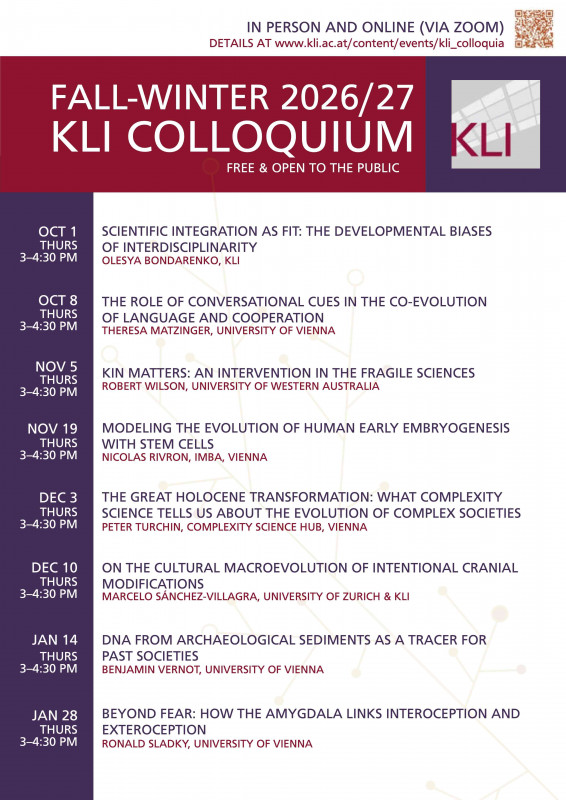
Scientific Integration as Fit: The Developmental Biases of Interdisciplinarity

Olesya BONDARENKO (KLI)


8 October 2026 (Thurs) 3-4:30 PM CET

The Role of Conversational Cues in the Co-Evolution of Language and Cooperation

Theresa MATZINGER (University of Vienna)


5 November 2026 (Thurs) 3-4:30 PM CET

Kin Matters: An Intervention in the Fragile Sciences

Robert A. WILSON (University of Western Australia)


19 November 2026 (Thurs) 3-4:30 PM CET

Modeling the Evolution of Human Early Embryogenesis with Stem Cells

Nicolas RIVRON (Institute of Molecular Biotechnology/IMBA, Vienna)


3 December 2026 (Thurs) 3-4:30 PM CET

The Great Holocene Transformation: What Complexity Science Tells Us About The Evolution of Complex Societies

Peter TURCHIN (Complexity Science Hub, Vienna)


10 December 2026 (Thurs) 3-4:30 PM CET

On the Cultural Macroevolution of Intentional Cranial Modifications

Marcelo SÁNCHEZ-VILLAGRA (University of Zurich)


14 January 2027 (Thurs) 3-4:30 PM CET

DNA from Archaeological Sediments as a Tracer for Past Societies

Benjamin VERNOT (University of Vienna)


28 January 2027 (Thurs) 3-4:30 PM CET

Beyond Fear: How the Amygdala Links Interoception and Exteroception

Ronald SLADKY (University of Vienna)


KLI Colloquia 2014 – 2026

Event Details
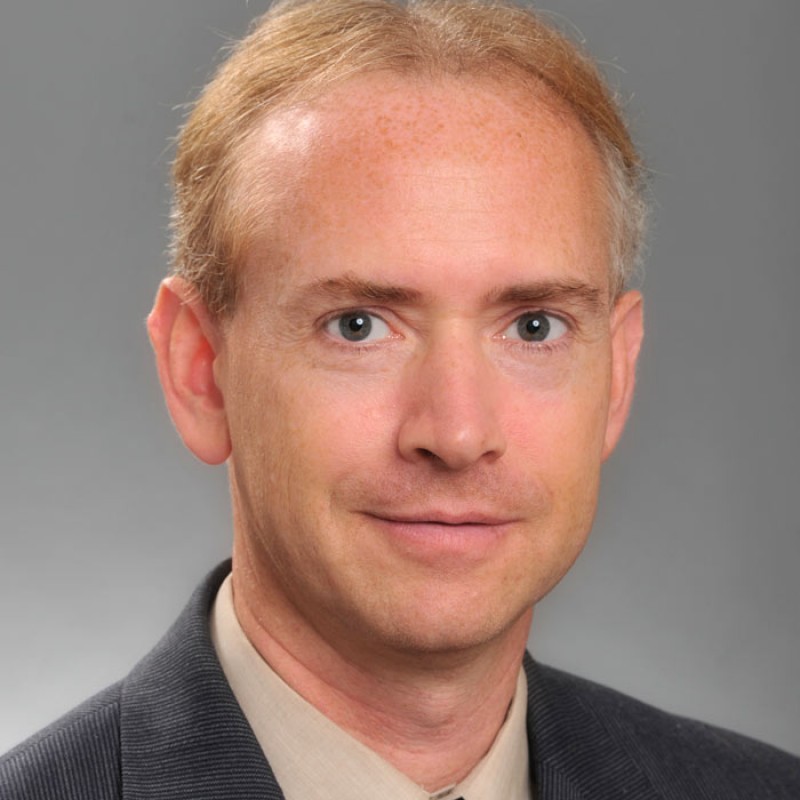
Brian Fath
KLI Colloquia
Foundations for Sustainability
Brian FATH (Towson University, Maryland & IIASA, Laxenburg)
2021-07-01 15:00 - 2021-07-01 17:00
Colloquium
Organized by KLI
Register in advance for this meeting:
After registering, you will receive a confirmation email containing information about joining the meeting. 
 
 
Topic description / abstract: 
This presentation reviews key concepts in sustainability and asks deep questions about why there are so many symptoms of environmental crises present in the world today (climate disruption, mass species extinctions, nitrogen cycle disruption, ocean acidification, crises with food, energy, and water, and many more).  These symptoms relate to the prevailing approach, in which we use reductionist mental models and treat living and environmental systems as if they are machines.  However, contrary to machines, ecological systems show much resilience and capacity to self-organize, regenerate, and increase their organization and complexity over time.  We believe that achieving a sustainable world will require a shift in the way we approach life and life sciences.  The good news is that such a shift is possible now, without the need of waiting for new technologies, and is limited only by our willingness. 
 

Biographical note:
Brian D. Fath is a Professor in the Department of Biological Sciences at Towson University (Maryland, USA) teaching courses on Ecosystem Ecology, Environmental Science, and Human Ecology.  He is also a Senior Research Scholar at the International Institute for Applied Systems Analysis (Laxenburg, Austria) and since 2011 the Scientific Coordinator of IIASA’ s Young Scientists Summer Program.  He has published over 200 research papers, reports, and book chapters on environmental systems modeling, specifically in the areas of network analysis, urban metabolism, and sustainability. He co-authored the books A New Ecology: Systems Perspective (2020), Foundations for Sustainability: A Coherent Framework of Life–Environment Relations (2019), and Flourishing within Limits to Growth: Following Nature’s Way (2015). Dr. Fath is also co-Editor-in-Chief for Current Research in Environmental Sustainability and past Editor in Chief of Ecological Modelling (2009 – 2020). He was the 2016 recipient of the Prigogine Medal for outstanding work in systems ecology and twice a Fulbright Distinguished Chair (Parthenope University, Naples, Italy, in 2012 and Masaryk University, Czech Republic, in 2019).