
KLI Colloquia are invited research talks of about an hour followed by 30 min discussion. The talks are held in English, open to the public, and offered in hybrid format.
Join via Zoom:
https://us02web.zoom.us/j/5881861923?omn=85945744831
Meeting ID: 588 186 1923
Fall-Winter 2026/27 KLI Colloquium Series
1 October 2026 (Thurs) 3-4:30 PM CET 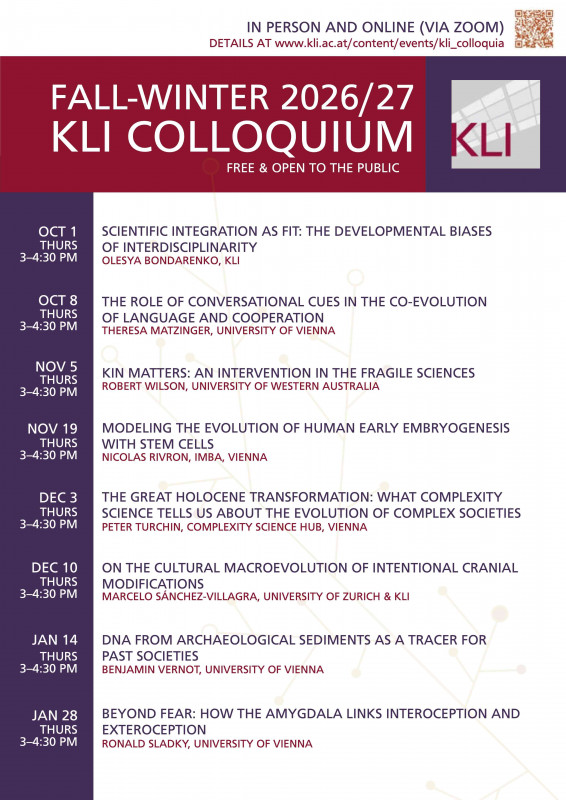
Scientific Integration as Fit: The Developmental Biases of Interdisciplinarity
Olesya BONDARENKO (KLI)
8 October 2026 (Thurs) 3-4:30 PM CET
The Role of Conversational Cues in the Co-Evolution of Language and Cooperation
Theresa MATZINGER (University of Vienna)
5 November 2026 (Thurs) 3-4:30 PM CET
Kin Matters: An Intervention in the Fragile Sciences
Robert A. WILSON (University of Western Australia)
19 November 2026 (Thurs) 3-4:30 PM CET
Modeling the Evolution of Human Early Embryogenesis with Stem Cells
Nicolas RIVRON (Institute of Molecular Biotechnology/IMBA, Vienna)
3 December 2026 (Thurs) 3-4:30 PM CET
Peter TURCHIN (Complexity Science Hub, Vienna)
10 December 2026 (Thurs) 3-4:30 PM CET
On the Cultural Macroevolution of Intentional Cranial Modifications
Marcelo SÁNCHEZ-VILLAGRA (University of Zurich)
14 January 2027 (Thurs) 3-4:30 PM CET
DNA from Archaeological Sediments as a Tracer for Past Societies
Benjamin VERNOT (University of Vienna)
28 January 2027 (Thurs) 3-4:30 PM CET
Beyond Fear: How the Amygdala Links Interoception and Exteroception
Ronald SLADKY (University of Vienna)
KLI Colloquia 2014 – 2026
Event Details
Topic description / abstract:
I argue that diversity and pluralism are valuable not just for science but for philosophy of science. Given the partiality and perspectivism of representation, pluralism preserving integration can increase accuracy. Perspectivism is often supported by appeal to visual representation. I draw further insights from multimodal sensory integration for under- standing experiment-based predictions of protein structure. The epistemic lessons learned from the scientific case also apply to philosophy of science itself. Finally, I suggest that a critical, nuanced philosophical view of legitimate sources of pluralism in science has an important role to play in public discourse.
Biographical note:
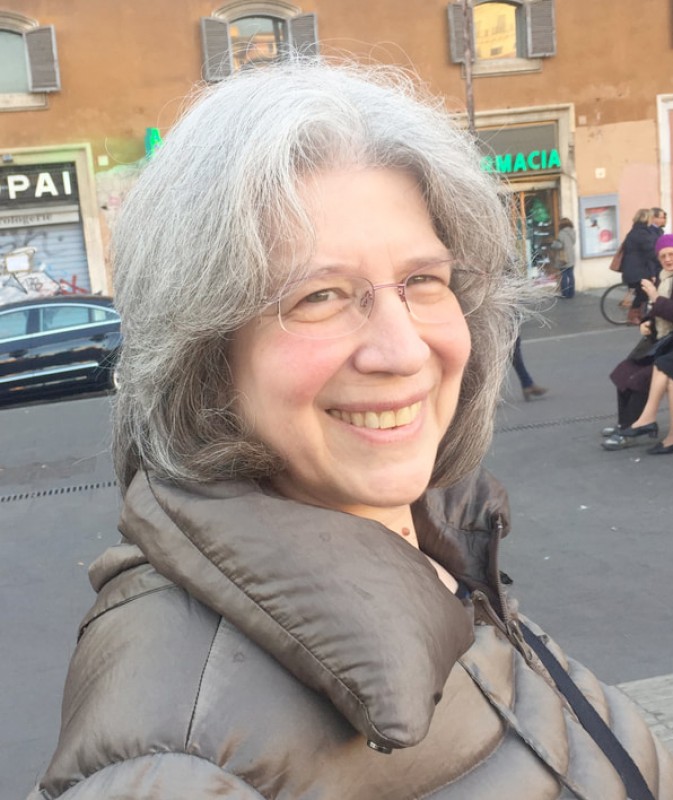
Sandra D. Mitchell is a Distinguished Professor of History and Philosophy of Science at the University of Pittsburgh. She works on a broad range of topics in philosophy of science, philosophy of biology and social science including functional explanation, emergence, models and laws. Her research focuses on scientific explanations of complex behavior, including self-organized division of labor in social insets, psychiatric genetics, and, most recently, protein structure and function. She has been a visiting fellow at Center for Interdisciplinary Studies, Bielefeld; the Institute for Advanced Studies, Berlin; The Max Planck Institute for History of Science, Berlin; and the Max Planck Institute for the Study of Societies, Cologne. Mitchell is the author of Biological Complexity and Integrative Pluralism (Cambridge University Press 2003) and Unsimple Truths: Science, Complexity and Policy (Univ. Chicago Press, 2009). She is a fellow of the American Association for the Advancement of Science, and served as President of the Philosophy of Science Association (2017-2019).
