

KLI Colloquia are invited research talks of about an hour followed by 30 min discussion. The talks are held in English, open to the public, and offered in hybrid format.
Join via Zoom:
https://us02web.zoom.us/j/5881861923?omn=85945744831
Meeting ID: 588 186 1923
Fall-Winter 2026/27 KLI Colloquium Series
1 October 2026 (Thurs) 3-4:30 PM CET 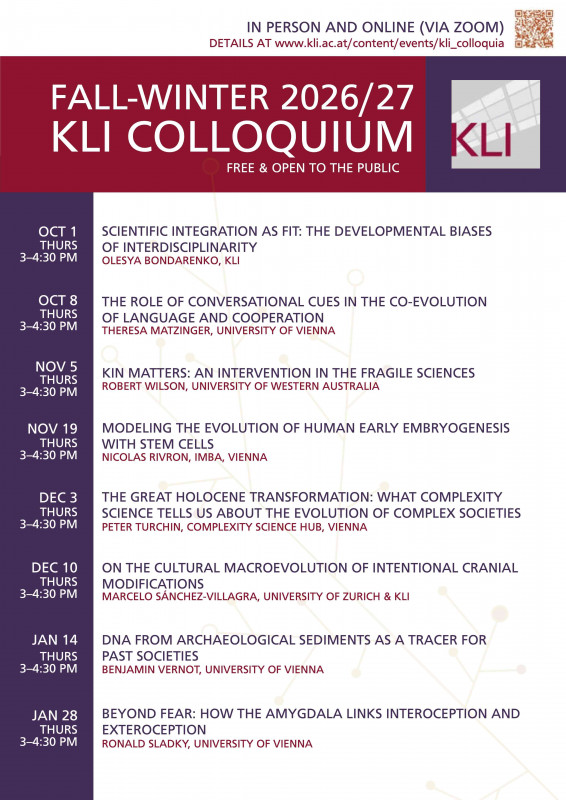
Scientific Integration as Fit: The Developmental Biases of Interdisciplinarity
Olesya BONDARENKO (KLI)
8 October 2026 (Thurs) 3-4:30 PM CET
The Role of Conversational Cues in the Co-Evolution of Language and Cooperation
Theresa MATZINGER (University of Vienna)
5 November 2026 (Thurs) 3-4:30 PM CET
Kin Matters: An Intervention in the Fragile Sciences
Robert A. WILSON (University of Western Australia)
19 November 2026 (Thurs) 3-4:30 PM CET
Modeling the Evolution of Human Early Embryogenesis with Stem Cells
Nicolas RIVRON (Institute of Molecular Biotechnology/IMBA, Vienna)
3 December 2026 (Thurs) 3-4:30 PM CET
Peter TURCHIN (Complexity Science Hub, Vienna)
10 December 2026 (Thurs) 3-4:30 PM CET
On the Cultural Macroevolution of Intentional Cranial Modifications
Marcelo SÁNCHEZ-VILLAGRA (University of Zurich)
14 January 2027 (Thurs) 3-4:30 PM CET
DNA from Archaeological Sediments as a Tracer for Past Societies
Benjamin VERNOT (University of Vienna)
28 January 2027 (Thurs) 3-4:30 PM CET
Beyond Fear: How the Amygdala Links Interoception and Exteroception
Ronald SLADKY (University of Vienna)
KLI Colloquia 2014 – 2026
Event Details
Please register here: https://greea.ca/%C3%A9v%C3%A8nement/mika-tosca-school-of-the-art-institute-of-chicago-kli-greea-colloquium/?instance_id=136 or here https://us02web.zoom.us/meeting/register/tZIsduusrTsvEtwrOSxAhu-VWU0nj6kzg1s2
Abstract:
As the climate crisis intensifies amidst ongoing public skepticism, much of the science remains abstruse, cumbersomely documented, and opaquely presented, making engagement with it by “nonscientists” difficult. Perhaps this is the reason why a segment of the population continues to assert that human beings are not responsible for the observed 21st century climate change. There exists, therefore, an exciting and necessary opportunity for scientists to collaborate with artists to not only improve the communication of climate science, but also to bolster the production of scientific knowledge. In this presentation I present the results of a collaborative project—inspired by that work—that combines the scientific method with the design process. This project elucidated the very real potential for art and design to dramatically improve the way climate research is conducted and communicated. I also introduce work from three collaborative projects by undergraduate artists, which explore ways that art and design can help us to collectively imagine (and build) future worlds in the aftermath of the climate crisis.
This event is jointly organized by the KLI and the Research Group in Environmental and Animal Ethics (GRÉEA): https://greea.ca/%C3%A9v%C3%A8nement/mika-tosca-school-of-the-art-institute-of-chicago-kli-greea-colloquium/?instance_id=136
Biographical note:
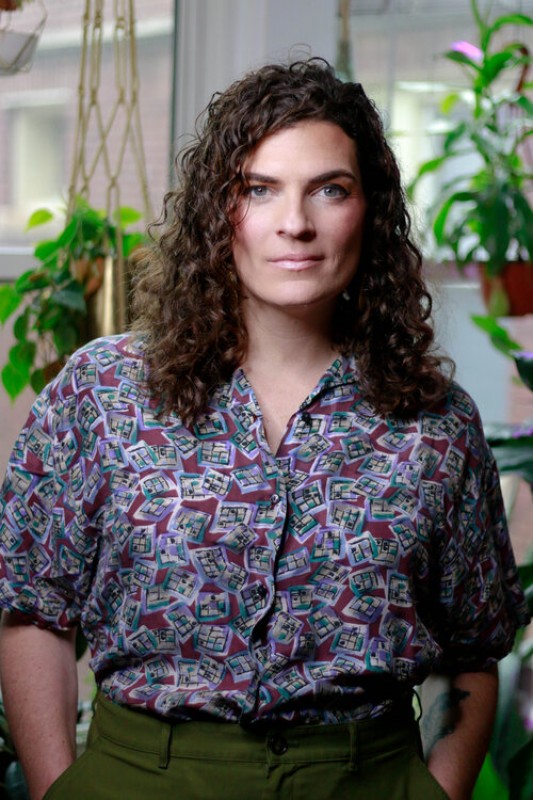
Dr. Tosca is a climate scientist, a humanist, an activist. She is an Assistant Professor at the School of the Art Institute of Chicago and an affiliate climate researcher at JPL (the Jet Propulsion Laboratory) in southern California.
Her current research and public outreach explores the the synthesis of art and climate science and posits that engaging with artists, designers, and makers is instrumental to solving the climate crisis. Mika is an out and proud transgender scientist (she/her pronouns) and a vocal advocate for the queer and trans communities in Chicago and beyond.
Dr. Tosca earned her Ph.D. in Earth System Science at University of California, Irvine, in the Earth System Science Department, where she was advised by Dr. Jim Randerson and Dr. Charlie Zender. Her doctoral thesis was titled: "Fire and Smoke in the Earth System: Evaluating the impact of fire aerosols on regional and global climate."
