

KLI Colloquia are invited research talks of about an hour followed by 30 min discussion. The talks are held in English, open to the public, and offered in hybrid format.
Join via Zoom:
https://us02web.zoom.us/j/5881861923?omn=85945744831
Meeting ID: 588 186 1923
Fall-Winter 2026/27 KLI Colloquium Series
1 October 2026 (Thurs) 3-4:30 PM CET 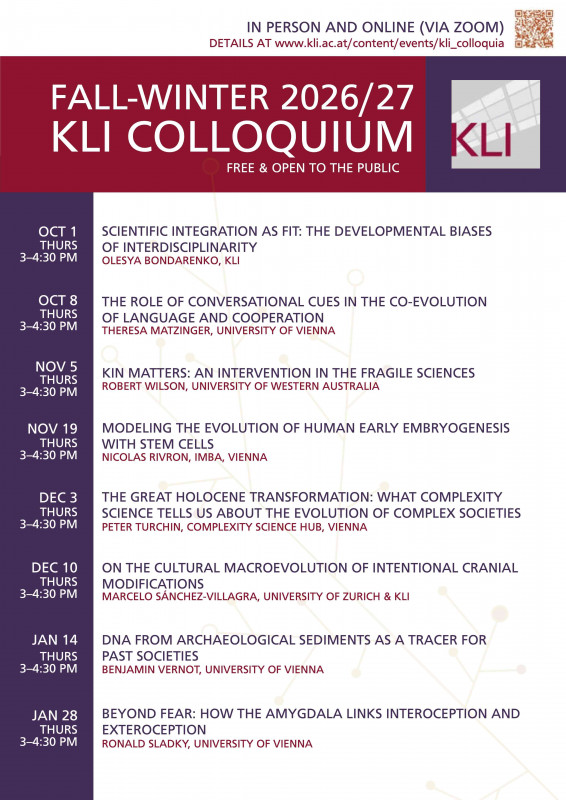
Scientific Integration as Fit: The Developmental Biases of Interdisciplinarity
Olesya BONDARENKO (KLI)
8 October 2026 (Thurs) 3-4:30 PM CET
The Role of Conversational Cues in the Co-Evolution of Language and Cooperation
Theresa MATZINGER (University of Vienna)
5 November 2026 (Thurs) 3-4:30 PM CET
Kin Matters: An Intervention in the Fragile Sciences
Robert A. WILSON (University of Western Australia)
19 November 2026 (Thurs) 3-4:30 PM CET
Modeling the Evolution of Human Early Embryogenesis with Stem Cells
Nicolas RIVRON (Institute of Molecular Biotechnology/IMBA, Vienna)
3 December 2026 (Thurs) 3-4:30 PM CET
Peter TURCHIN (Complexity Science Hub, Vienna)
10 December 2026 (Thurs) 3-4:30 PM CET
On the Cultural Macroevolution of Intentional Cranial Modifications
Marcelo SÁNCHEZ-VILLAGRA (University of Zurich)
14 January 2027 (Thurs) 3-4:30 PM CET
DNA from Archaeological Sediments as a Tracer for Past Societies
Benjamin VERNOT (University of Vienna)
28 January 2027 (Thurs) 3-4:30 PM CET
Beyond Fear: How the Amygdala Links Interoception and Exteroception
Ronald SLADKY (University of Vienna)
KLI Colloquia 2014 – 2026
Event Details
Topic description / abstract:
In my talk, I will explore the potential of the niche and niche construction concepts to analyse contemporary social-ecological phenomena and associated sustainability dilemma. It will consist of three main parts: In the first part, I will present insights from empirical and applied investigations of how contemporary human societies (nation states) interact with the natural environment through land and material use and how they manage to construct niches with the aid of non-renewable resources and teleconnections, i.e., the shifting of environmental burdens to far away places. I will lay special emphasis on issues of global justice and equality. The second part will present insights from a literature review on niches in different disciplines to get a systematic understanding of what niches are in different disciplines and how they work in different research fields. Results are analysed in a comparative manner and also from a social-ecological sustainability perspective. The third part will integrate findings from the previous two sections and discuss a new conception of social-ecological niche construction to investigate current sustainability problems from a new perspective and to possibly lay the ground for more social-ecological niche studies in the future.
Biographical note:
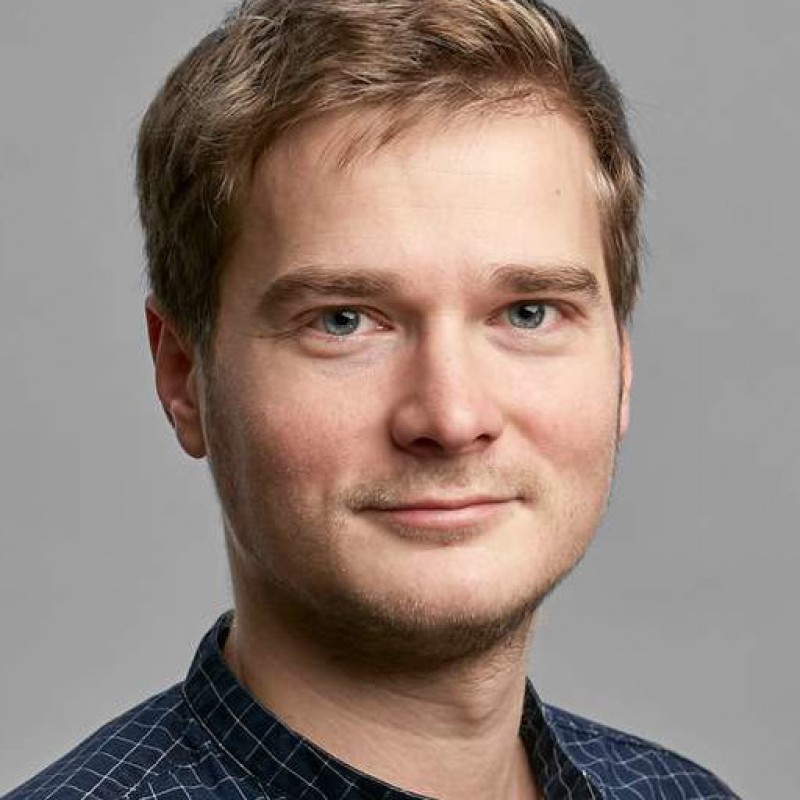
Christian Dorninger obtained his PhD from the Faculty of Sustainability at the Leuphana University Lüneburg, Germany, and currently holds a PostDoc fellowship at the KLI and is also affiliated with the Institute of Social Ecology at BOKU University in Vienna. Christian has a background in social ecology, ecological economics, and sustainability science. His research interest lies in the interdisciplinary exploration of human-nature interactions across scales and the identification of sustainability issues therein. He applies different methodological approaches to study phenomena of production and consumption systems, land and material use, biophysical aspects of international trade and development, teleconnections and ecologically unequal exchange, as well as the sustainability transformation. At the KLI he explores the potential of the niche concept to better understand contemporary social-ecological phenomena, pathway dependencies and the possibility of sustainable niche construction.
