
KLI Colloquia are invited research talks of about an hour followed by 30 min discussion. The talks are held in English, open to the public, and offered in hybrid format.
Join via Zoom:
https://us02web.zoom.us/j/5881861923?omn=85945744831
Meeting ID: 588 186 1923
Fall-Winter 2026/27 KLI Colloquium Series
1 October 2026 (Thurs) 3-4:30 PM CET 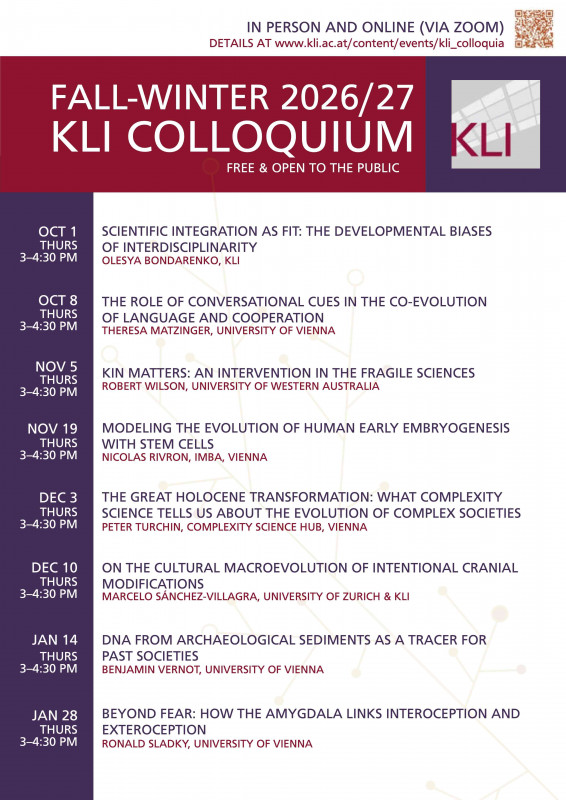
Scientific Integration as Fit: The Developmental Biases of Interdisciplinarity
Olesya BONDARENKO (KLI)
8 October 2026 (Thurs) 3-4:30 PM CET
The Role of Conversational Cues in the Co-Evolution of Language and Cooperation
Theresa MATZINGER (University of Vienna)
5 November 2026 (Thurs) 3-4:30 PM CET
Kin Matters: An Intervention in the Fragile Sciences
Robert A. WILSON (University of Western Australia)
19 November 2026 (Thurs) 3-4:30 PM CET
Modeling the Evolution of Human Early Embryogenesis with Stem Cells
Nicolas RIVRON (Institute of Molecular Biotechnology/IMBA, Vienna)
3 December 2026 (Thurs) 3-4:30 PM CET
Peter TURCHIN (Complexity Science Hub, Vienna)
10 December 2026 (Thurs) 3-4:30 PM CET
On the Cultural Macroevolution of Intentional Cranial Modifications
Marcelo SÁNCHEZ-VILLAGRA (University of Zurich)
14 January 2027 (Thurs) 3-4:30 PM CET
DNA from Archaeological Sediments as a Tracer for Past Societies
Benjamin VERNOT (University of Vienna)
28 January 2027 (Thurs) 3-4:30 PM CET
Beyond Fear: How the Amygdala Links Interoception and Exteroception
Ronald SLADKY (University of Vienna)
KLI Colloquia 2014 – 2026
Event Details
Topic description / abstract:
Contributing to a better understanding of contemporary issues of environmental sustainability from a historical perspective, this book provides a cohesive and cogent account of the history of ecological economic thought. The work unearths a diverse set of ideas within a Western and Slavic context, from the Renaissance and the Enlightenment to the late 1940s, to reveal insights firmly grounded in historiographical research and of import for addressing current sustainability challenges, not least by means of improving our grasp on how humans and nature can generously coexist in the long term. The history of ecological economic thought offered in this volume is rich and diverse, encompassing views that are bound by the observance of the tenets of the natural sciences, but which differ significantly in terms of the role of energy and materials to cultural development and the normative aspects involving resource distribution, social ideals, and policy-making. Combining the approaches of independent scholarly figures and scientific communities from different historical periods and nationalities, the book brings elements that are still missing in the scarce literature on the history of ecological economic thought and highlights the underlying threads which unite such initiatives. The book brings a fresh look into the historical development of ecological economic ideas and will therefore be of great interest to scholars and students of ecological economics, environmental economics, sustainability science, interdisciplinary studies, and history of economic thought.
Biographical note:
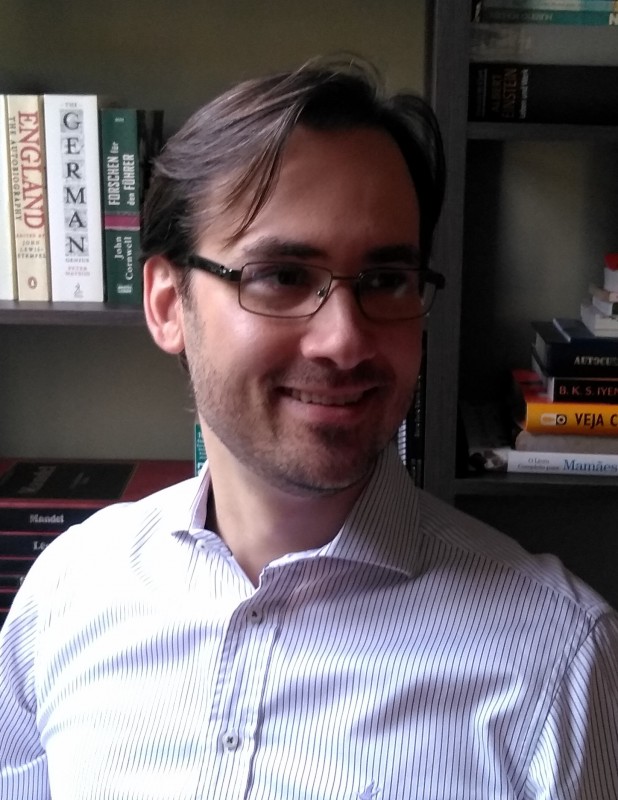
Marco Vianna Franco is a postdoctoral fellow at the Konrad Lorenz Institute for Evolution and Cognition Research in Klosterneuburg, Austria, and holds a PhD in economics from the Universidade Federal de Minas Gerais (Cedeplar/UFMG) in Belo Horizonte, Brazil. He works in the fields of ecological economics and history of economic thought with a focus on human–nature relations from the perspectives of political economy, intellectual history, and philosophy of science.
Link to book: https://www.routledge.com/A-History-of-Ecological-Economic-Thought/Franco-Missemer/p/book/9780367363925
