

KLI Colloquia are invited research talks of about an hour followed by 30 min discussion. The talks are held in English, open to the public, and offered in hybrid format.
Join via Zoom:
https://us02web.zoom.us/j/5881861923?omn=85945744831
Meeting ID: 588 186 1923
Fall-Winter 2026/27 KLI Colloquium Series
1 October 2026 (Thurs) 3-4:30 PM CET 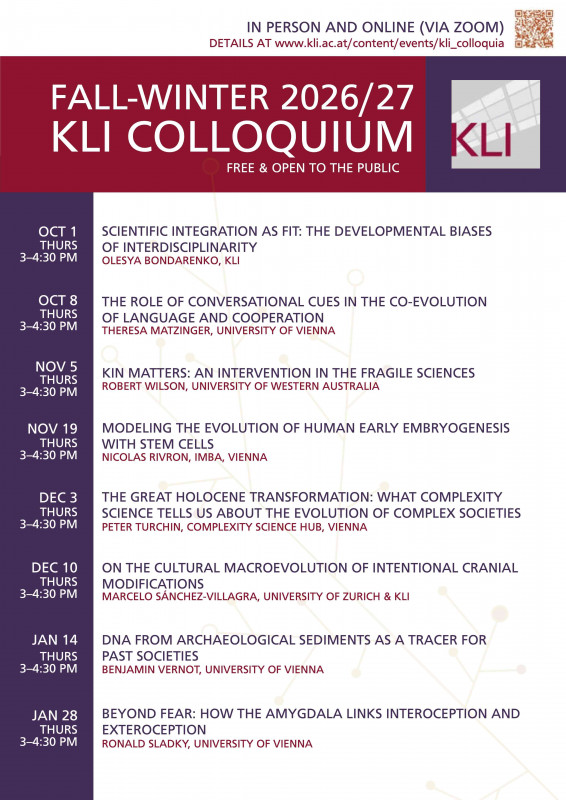
Scientific Integration as Fit: The Developmental Biases of Interdisciplinarity
Olesya BONDARENKO (KLI)
8 October 2026 (Thurs) 3-4:30 PM CET
The Role of Conversational Cues in the Co-Evolution of Language and Cooperation
Theresa MATZINGER (University of Vienna)
5 November 2026 (Thurs) 3-4:30 PM CET
Kin Matters: An Intervention in the Fragile Sciences
Robert A. WILSON (University of Western Australia)
19 November 2026 (Thurs) 3-4:30 PM CET
Modeling the Evolution of Human Early Embryogenesis with Stem Cells
Nicolas RIVRON (Institute of Molecular Biotechnology/IMBA, Vienna)
3 December 2026 (Thurs) 3-4:30 PM CET
Peter TURCHIN (Complexity Science Hub, Vienna)
10 December 2026 (Thurs) 3-4:30 PM CET
On the Cultural Macroevolution of Intentional Cranial Modifications
Marcelo SÁNCHEZ-VILLAGRA (University of Zurich)
14 January 2027 (Thurs) 3-4:30 PM CET
DNA from Archaeological Sediments as a Tracer for Past Societies
Benjamin VERNOT (University of Vienna)
28 January 2027 (Thurs) 3-4:30 PM CET
Beyond Fear: How the Amygdala Links Interoception and Exteroception
Ronald SLADKY (University of Vienna)
KLI Colloquia 2014 – 2026
Event Details
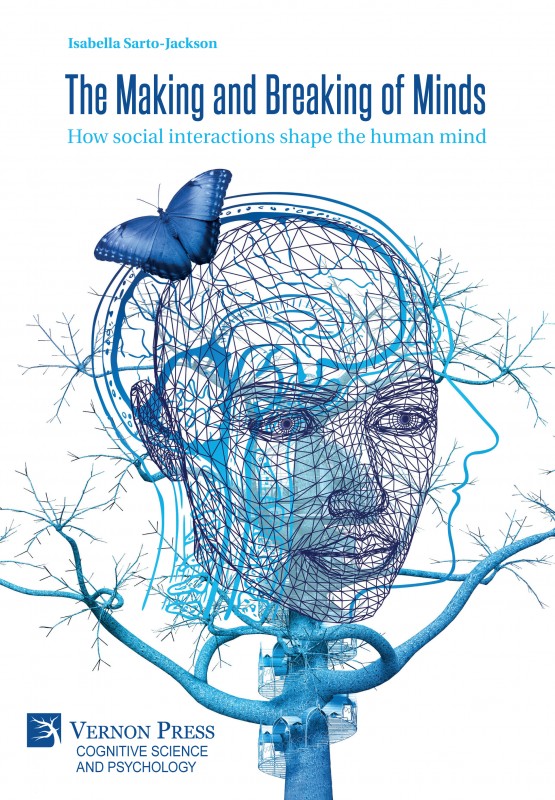
Topic description / abstract:
The human brain reorganizes itself and flexibly adjusts to fluctuating environmental conditions by means of neuroplastic processes. Neuroplasticity provides the basis for wide-ranging learning and memory processes that are particularly profuse during childhood and adolescence. At the same time, the exceptional malleability of the developing brain leaves it highly vulnerable to negative impact from the surroundings.
Abusive or neglecting social environments as well as socioeconomic deprivation cause physiological stress responses that can severely compromise cognitive development, emotional processing, and executive brain functions by altering the underlying neurobiochemical homeostasis. Importantly, such detrimental neurophysiological consequences are not limited to the affected individual but can be transmitted to the offspring through a process of social niche construction.
Proof of concept is supported by research on transgenerational trauma.
Link to book: https://vernonpress.com/book/387
Biographical note:
Isabella Sarto-Jackson is a neurobiologist, executive manager of the Konrad Lorenz Institute for Evolution and Cognition Research, and president of the Austrian Neuroscience Association (ANA). She holds a Master´s degree in genetics, a PhD in neurobiochemistry, and the venia docendi in neurobiology. She has worked as a neuroscientist at the Center for Brain Research of the Medical University in Vienna and extended her research focus to cognitive science and evolutionary biology since joining the KLI in 2011.
Her work is highly interdisciplinary – at the interface of neurobiology, cognitive science, evolutionary biology, and social education.
Link to ISJ´s website: www.sarto-jackson.com
