

KLI Colloquia are invited research talks of about an hour followed by 30 min discussion. The talks are held in English, open to the public, and offered in hybrid format.
Join via Zoom:
https://us02web.zoom.us/j/5881861923?omn=85945744831
Meeting ID: 588 186 1923
Fall-Winter 2026/27 KLI Colloquium Series
1 October 2026 (Thurs) 3-4:30 PM CET 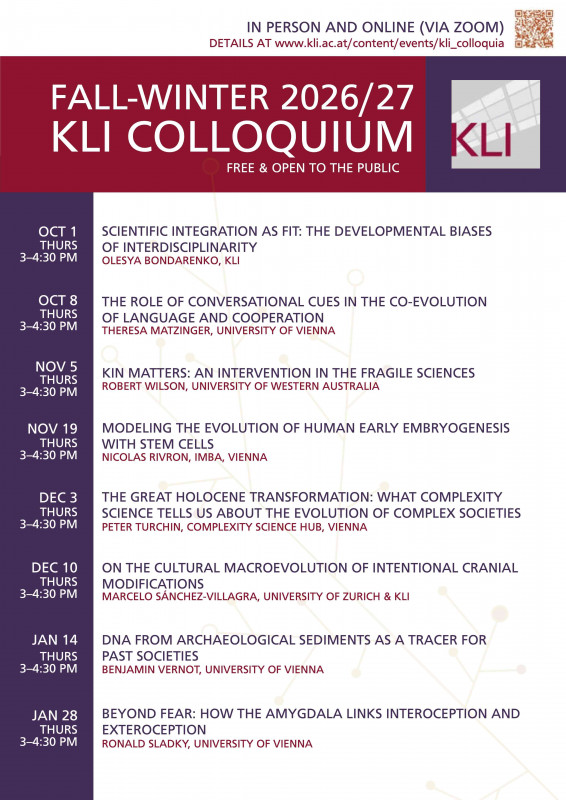
Scientific Integration as Fit: The Developmental Biases of Interdisciplinarity
Olesya BONDARENKO (KLI)
8 October 2026 (Thurs) 3-4:30 PM CET
The Role of Conversational Cues in the Co-Evolution of Language and Cooperation
Theresa MATZINGER (University of Vienna)
5 November 2026 (Thurs) 3-4:30 PM CET
Kin Matters: An Intervention in the Fragile Sciences
Robert A. WILSON (University of Western Australia)
19 November 2026 (Thurs) 3-4:30 PM CET
Modeling the Evolution of Human Early Embryogenesis with Stem Cells
Nicolas RIVRON (Institute of Molecular Biotechnology/IMBA, Vienna)
3 December 2026 (Thurs) 3-4:30 PM CET
Peter TURCHIN (Complexity Science Hub, Vienna)
10 December 2026 (Thurs) 3-4:30 PM CET
On the Cultural Macroevolution of Intentional Cranial Modifications
Marcelo SÁNCHEZ-VILLAGRA (University of Zurich)
14 January 2027 (Thurs) 3-4:30 PM CET
DNA from Archaeological Sediments as a Tracer for Past Societies
Benjamin VERNOT (University of Vienna)
28 January 2027 (Thurs) 3-4:30 PM CET
Beyond Fear: How the Amygdala Links Interoception and Exteroception
Ronald SLADKY (University of Vienna)
KLI Colloquia 2014 – 2026
Event Details
Topic description / abstract:
At the KLI colloquium, Federica Russo will present her new book: "Techno-Scientific Practices : An Informational Approach”
As heir of Greek thinking, we are used to separate science from technology, episteme from techne, philosophy of science from philosophy of technology. A closer look at the practice of science, however, shows that technologies are more than mediating instruments – they are part and parcel of the process of knoweldge production. In this talk, I shall present the main line of argument of my latest monograph Techno-Scientific Practices. An Informational Approach (RLI, 2022). I reconstruct how the gap between (Phil) Tech and (Phil) Sci came about and suggest that neglected traditions such as French Epistemology and current approaches such as the Philosophy of Science in Practice can bridge the gap. In particular, turning our attention to techno-scientific practices, I shall argue, helps us recognise the ways in which we human epistemic agents produce knowledge together with artificial epistemic agents. I sketch the contours of an epistemology for techno-scientific practices, one in which classic concepts of ‘model’, ‘evidence’, ’truth’, and ‘knowledge’ need to be redesigned. I cash out the idea of knowledge co-production with the concept of poiêsis, and anticipate some of the challenges ahead, notably about ontological and normative questions.
Biographical note:
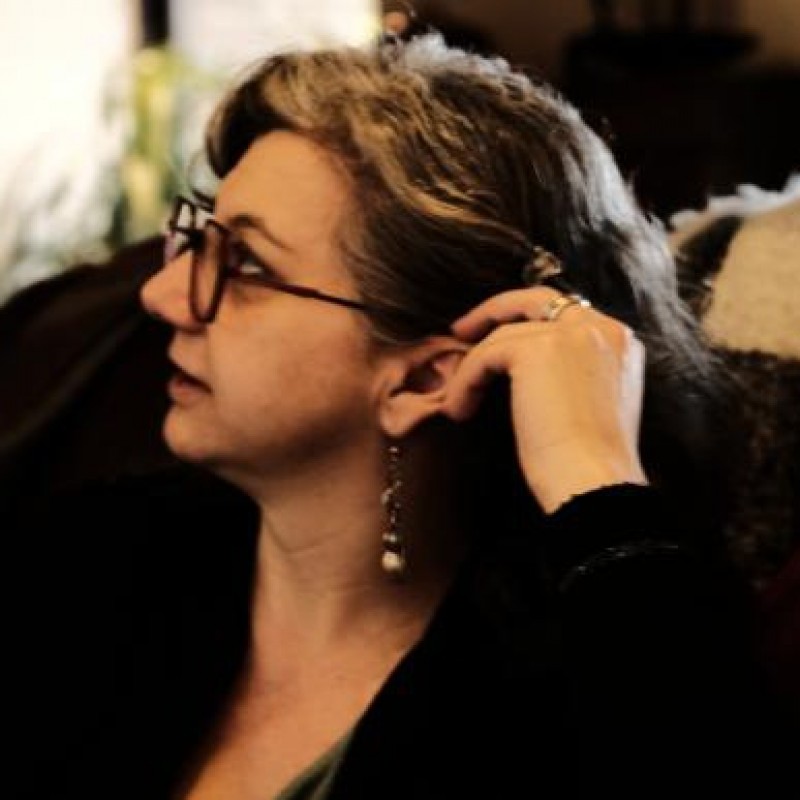
Federica Russo is a philosopher of science, technology, and information. She is Honorary Professor at University College London (Department of Science and Technology Studies), and lectures at the University of Amsterdam (Department of Philosophy and Institute for Interdisciplinary Studies). At the UvA, Federica carries out research at the Institute for Logic, Language and Computation, and within the Language and Cognition in Argumentation Group.
Her research concerns epistemological, methodological, and normative aspects they arise in the health and social sciences, with special attention to policy contexts and to the highly technologized character of these fields. Federica has published extensively on various themes, such as causation and causal modelling, evidence, and technology, and her latest monograph is titled Techno-Scientific Practices : An Informational Approach (RLI, 2022).
Federica has been co-editor in chief (with Phyllis Illari) of the European Journal for Philosophy of Science and an executive Editor of Philosophy and Technology, while she is currently Editor-in-Chief of Digital Society.
Federica sits in the Management Team of the Institute for Advanced Study at the University of Amsterdam, and is member of the Steering Committee of the European Philosophy of Science Association.
For more information please visit russofederica.wordpress.com or follow her on Twitter @federicarusso
