

KLI Colloquia are invited research talks of about an hour followed by 30 min discussion. The talks are held in English, open to the public, and offered in hybrid format.
Join via Zoom:
https://us02web.zoom.us/j/5881861923?omn=85945744831
Meeting ID: 588 186 1923
Fall-Winter 2026/27 KLI Colloquium Series
1 October 2026 (Thurs) 3-4:30 PM CET 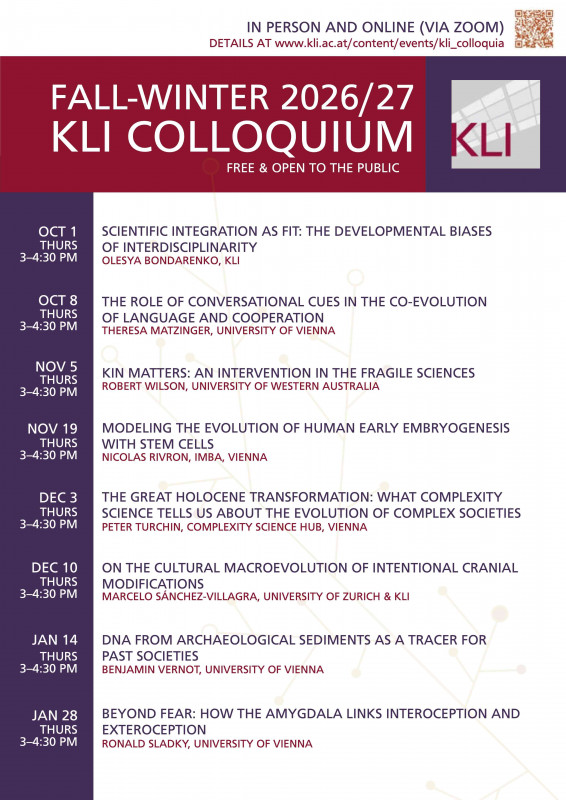
Scientific Integration as Fit: The Developmental Biases of Interdisciplinarity
Olesya BONDARENKO (KLI)
8 October 2026 (Thurs) 3-4:30 PM CET
The Role of Conversational Cues in the Co-Evolution of Language and Cooperation
Theresa MATZINGER (University of Vienna)
5 November 2026 (Thurs) 3-4:30 PM CET
Kin Matters: An Intervention in the Fragile Sciences
Robert A. WILSON (University of Western Australia)
19 November 2026 (Thurs) 3-4:30 PM CET
Modeling the Evolution of Human Early Embryogenesis with Stem Cells
Nicolas RIVRON (Institute of Molecular Biotechnology/IMBA, Vienna)
3 December 2026 (Thurs) 3-4:30 PM CET
Peter TURCHIN (Complexity Science Hub, Vienna)
10 December 2026 (Thurs) 3-4:30 PM CET
On the Cultural Macroevolution of Intentional Cranial Modifications
Marcelo SÁNCHEZ-VILLAGRA (University of Zurich)
14 January 2027 (Thurs) 3-4:30 PM CET
DNA from Archaeological Sediments as a Tracer for Past Societies
Benjamin VERNOT (University of Vienna)
28 January 2027 (Thurs) 3-4:30 PM CET
Beyond Fear: How the Amygdala Links Interoception and Exteroception
Ronald SLADKY (University of Vienna)
KLI Colloquia 2014 – 2026
Event Details
You are invited to a Zoom meeting.
When: Oct 5, 2023 03:00 PM Vienna
Register in advance for this meeting:
https://us02web.zoom.us/meeting/register/tZMld--orD8pE9TaDu6CnEAEtQReJ-axcNhq
After registering, you will receive a confirmation email containing information about joining the meeting.
Topic description / abstract:
I argue that the question of animal consciousness is an extrapolation problem and, as such, is best tackled by deploying currently accepted methodology for validating experimental models of a phenomenon of interest. This methodology relies on an assessment of similarities and dissimilarities between experimental models, the partial replication of findings across complementary models, and evidence from the successes and failures of explanations, technologies and medical applications developed by extrapolating and aggregating findings from multiple models. Crucially important, this methodology does not require a commitment to any particular theory or construct of consciousness, thus avoiding theory-biased reinterpretations of empirical findings rampant in the literature.
Biographical note:
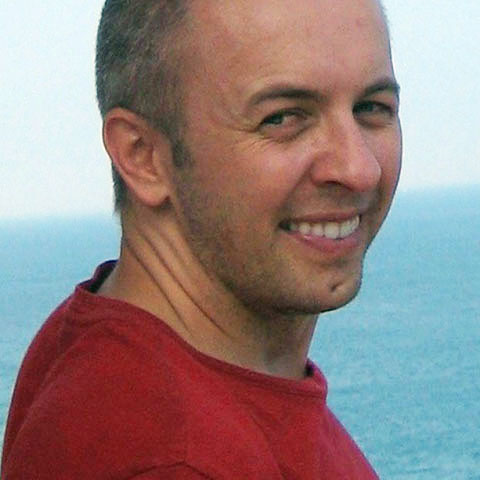
Tudor Baetu received a master’s degree in microbiology and immunology from McGill University and a doctorate degree in philosophy from Université de Montréal. He held post-doctoral positions at the University of Maryland (College Park, USA) and the Konrad Lorenz Institute (Klosterneuburg, Austria), followed by an associate professor position at Universidade do Vale do Rio dos Sinos (São Leopoldo, Brazil). He was a lecturer in philosophy of science at the University of Bristol and is now Associate Professor at the Université du Québec à Trois-Rivières (UQTR) in Canada.
