
KLI Colloquia are invited research talks of about an hour followed by 30 min discussion. The talks are held in English, open to the public, and offered in hybrid format.
Join via Zoom:
https://us02web.zoom.us/j/5881861923?omn=85945744831
Meeting ID: 588 186 1923
Fall-Winter 2026/27 KLI Colloquium Series
1 October 2026 (Thurs) 3-4:30 PM CET 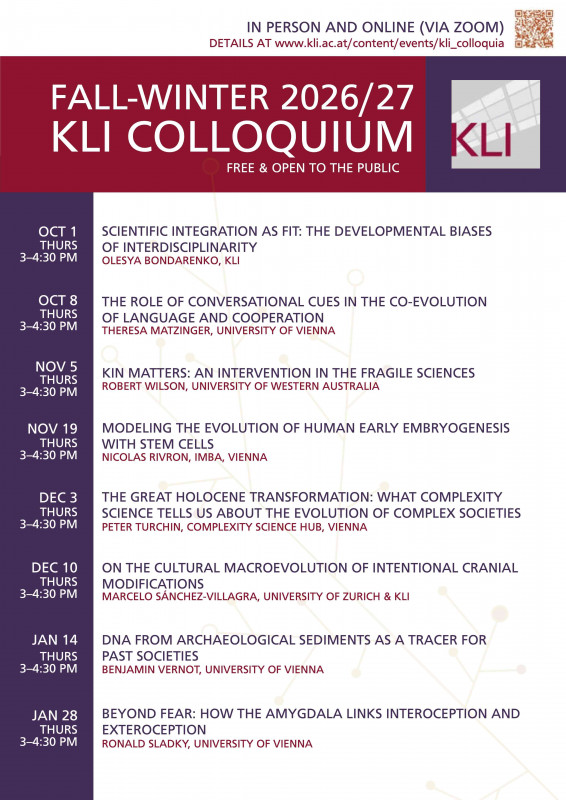
Scientific Integration as Fit: The Developmental Biases of Interdisciplinarity
Olesya BONDARENKO (KLI)
8 October 2026 (Thurs) 3-4:30 PM CET
The Role of Conversational Cues in the Co-Evolution of Language and Cooperation
Theresa MATZINGER (University of Vienna)
5 November 2026 (Thurs) 3-4:30 PM CET
Kin Matters: An Intervention in the Fragile Sciences
Robert A. WILSON (University of Western Australia)
19 November 2026 (Thurs) 3-4:30 PM CET
Modeling the Evolution of Human Early Embryogenesis with Stem Cells
Nicolas RIVRON (Institute of Molecular Biotechnology/IMBA, Vienna)
3 December 2026 (Thurs) 3-4:30 PM CET
Peter TURCHIN (Complexity Science Hub, Vienna)
10 December 2026 (Thurs) 3-4:30 PM CET
On the Cultural Macroevolution of Intentional Cranial Modifications
Marcelo SÁNCHEZ-VILLAGRA (University of Zurich)
14 January 2027 (Thurs) 3-4:30 PM CET
DNA from Archaeological Sediments as a Tracer for Past Societies
Benjamin VERNOT (University of Vienna)
28 January 2027 (Thurs) 3-4:30 PM CET
Beyond Fear: How the Amygdala Links Interoception and Exteroception
Ronald SLADKY (University of Vienna)
KLI Colloquia 2014 – 2026
Event Details
You are invited to a scheduled Zoom meeting.
Topic: KLI Colloquium: Searching for the boundaries of brain circuit disorders – Marco TREVEN
Time: Nov 16, 2023 03:00 PM Vienna
Register at:
Topic description / abstract:
Neurology has traditionally prided itself on localizing symptoms to distinct brain structures, reflecting an age-old model that pinpoints specific functions to precise brain sites. However, since the development of the computer and the later rise of network science, our understanding of neurological disorders has been reshaped. Terms such as "circuit disorders" and "circuitopathies" encapsulate this shift, emphasizing the interconnectedness of brain regions. Emblematic of this paradigm change are institutes like the Center for Brain Circuit Therapeutics in Boston and the Center for Advanced Circuit Therapeutics in New York City.
Against this backdrop, this presentation explores the transformative nature of the network model in neurology. I will go into its definition, visualization, boundaries, and modulation. Within this network-centric view, it's pivotal to recognize that multiple or distributed perturbations may lead to distinct symptoms or phenomena or impair the synchronized exchange of information between networks. The historical development of deep brain stimulation surgery will provide an example of a modulatory method that evolved in tandem with the network model. Moving beyond an individual-centric perspective, there's an increasing recognition that feedback control extends outside just the brain and body. The profound influence of environmental and social interactions on the burden of neuropsychiatric disorders suggests that the boundaries relevant for understanding brain disorders might be more expansive than traditionally believed. Embracing this extended perspective may help to account for therapeutic interventions such as art and sports therapy, cueing devices, exposure therapy, and sensory shielding strategies. Furthermore, the talk will touch upon the burgeoning field of interpersonal synchronization, highlighting the intriguing interplay between brain disorders and our inherent social abilities. I will conclude that multiple possible boundaries can be drawn for brain disorders, depending on the precise phenomena and interventions being investigated.
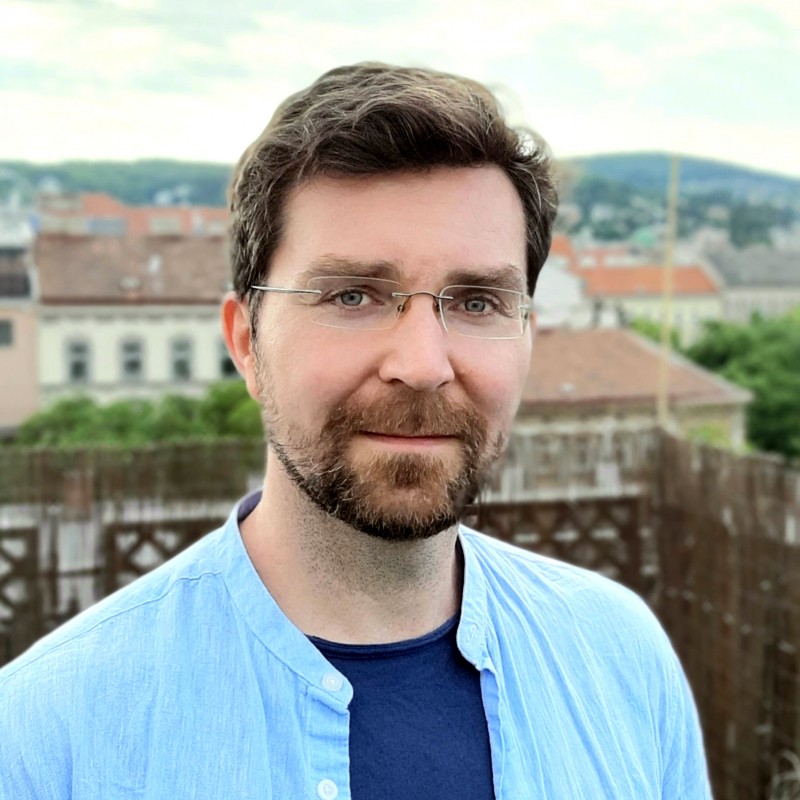
Biographical note:
Marco Treven is a resident at the Department of Neurology at the Medical University of Vienna (MUW). He completed his medical studies at the MUW and moved on to a PhD within the thematical program "Cell Communication in Health and Disease (CCHD)." Under the supervision of Prof. Stefan Böhm, he defended his thesis titled "Extrasynaptic GABAA Receptors in Neurological Disease." Following this, he secured a postdoc position with Prof. Margot Ernst at the Center for Brain Research of the MUW, specializing in GABAA receptor pharmacology. His professional trajectory took him on clinical training journeys to the UK and Germany, and a research stay at UCLA in the Istvan Mody lab at the David Geffen School of Medicine, Departments of Neurology and Physiology. Dr. Treven's most recent role was as a resident fellow at the Konrad Lorenz Institute (KLI), where he delved deep into theoretical and conceptual advances in neurological disorders, viewing them as phenomena of extended brain networks responding to a continuous flux of environmental signals. He harbors a keen interest in movement disorder neurology, specifically in advanced invasive methods like deep brain stimulation and focused ultrasound. Moreover, he connects the clinical work to his foundational expertise in basic pharmacological research. He has authored and co-authored many peer-reviewed publications, primarily focusing on extrasynaptic GABA currents, Parkinson's Disease, Dystonia, Epilepsy, and the therapeutic potential of physical activity and creative expression for neurodegenerative disorders.
