Events

KLI Colloquia are invited research talks of about an hour followed by 30 min discussion. The talks are held in English, open to the public, and offered in hybrid format. 

Join via Zoom:
https://us02web.zoom.us/j/5881861923?omn=85945744831
Meeting ID: 588 186 1923

Fall–Winter 2026/27 KLI Colloquium Series

1 October 2026 (Thurs) 3-4:30 PM CET
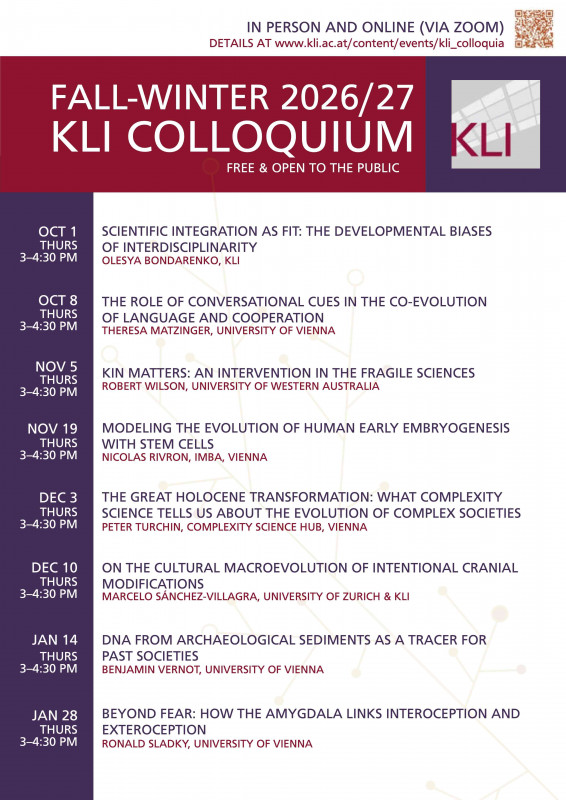
Scientific Integration as Fit: The Developmental Biases of Interdisciplinarity

Olesya BONDARENKO (KLI)


8 October 2026 (Thurs) 3-4:30 PM CET

The Role of Conversational Cues in the Co-Evolution of Language and Cooperation

Theresa MATZINGER (University of Vienna)


5 November 2026 (Thurs) 3-4:30 PM CET

Kin Matters: An Intervention in the Fragile Sciences

Robert A. WILSON (University of Western Australia)


19 November 2026 (Thurs) 3-4:30 PM CET

TBA

Nicolas RIVRON (Institute of Molecular Biotechnology/IMBA, Vienna)


3 December 2026 (Thurs) 3-4:30 PM CET

The Great Holocene Transformation: What Complexity Science Tells Us About The Evolution of Complex Societies

Peter TURCHIN (Complexity Science Hub, Vienna)


10 December 2026 (Thurs) 3-4:30 PM CET

On the Cultural Macroevolution of Intentional Cranial Modifications

Marcelo SÁNCHEZ-VILLAGRA (University of Zurich)


14 January 2027 (Thurs) 3-4:30 PM CET

DNA from Archaeological Sediments as a Tracer for Past Societies

Benjamin VERNOT (University of Vienna)


28 January 2027 (Thurs) 3-4:30 PM CET

Beyond Fear: How the Amygdala Links Interoception and Exteroception

Ronald SLADKY (University of Vienna)


KLI Colloquia 2014 – 2026

Event Details

Markus Peschl
KLI Colloquia
Socio-Epistemic and Material Pathways to Novelty and Innovation
Markus F. PESCHL (University of Vienna)
2023-11-23 15:00 - 2023-11-23 17:00
KLI
Organized by KLI
You are invited to a Zoom meeting. 
When: Nov 23, 2023 03:00 PM Vienna 
Register in advance for this meeting:
After registering, you will receive a confirmation email containing information about joining the meeting.
 
Topic description / abstract:
This presentation explores the sources of creativity, knowledge creation, and innovation by framing them as socio-epistemic and material activities, emphasizing the interaction between cognitive systems and their material and social environments. Departing from traditional views, we adopt enactivist concepts such as participatory sense-making, engaged epistemology (De Jaegher), and Material Engagement Theory (Malafouris), suggesting that creative processes involve active interaction with the world, leading to the emergence of novelty. This challenges the classic (mostly hylomorphic) understanding of creativity and knowledge creation, as „creative agency“ is—at least in part—shifted from the creator’s mind to the environment and to interacting/engaging with an unfolding world.
Abandoning (epistemic) control in favor of openness to and engaging with emerging affordances and (future) potentials is key in such an approach. Creative activities will be conceived as processes of co-becoming, undergoing, and correspondence with the world (e.g., Ingold). In this context, the concept of resonance introduces a future-oriented and sustainable development perspective, as the involved systems co-create their future in the form of mutually beneficial environments and niches. The presentation discusses theoretical foundations and practical consequences, advocating for alternative cognitive skills, attitudes, and environmental structures to foster co-creation with an evolving world.
 
 
Biographical note:
Markus Peschl is Professor of Cognitive Science at the University of Vienna. His research is driven by the question how novelty and innovation come into the world. His research areas include innovation, knowledge creation, cognitive science, organizational design and strategy, futures literacy, design, and Enabling Spaces. He is one of the founders of the inter-faculty interdisciplinary Cognitive Science Hub at the University of Vienna and the director of the international Middle European Joint Masters Program in Cognitive Science. Markus spent several years as a postdoctoral researcher at the University of California, San Diego and the University of Sussex. He is co-founder and CSO of theLivingCore Innovation and Knowledge Architects and holds several visiting professorships at European universities. Markus Peschl has published more than 160 articles and six books.
For further information see: https://homepage.univie.ac.at/franz-markus.peschl/