

KLI Colloquia are invited research talks of about an hour followed by 30 min discussion. The talks are held in English, open to the public, and offered in hybrid format.
Join via Zoom:
https://us02web.zoom.us/j/5881861923?omn=85945744831
Meeting ID: 588 186 1923
Fall-Winter 2026/27 KLI Colloquium Series
1 October 2026 (Thurs) 3-4:30 PM CET 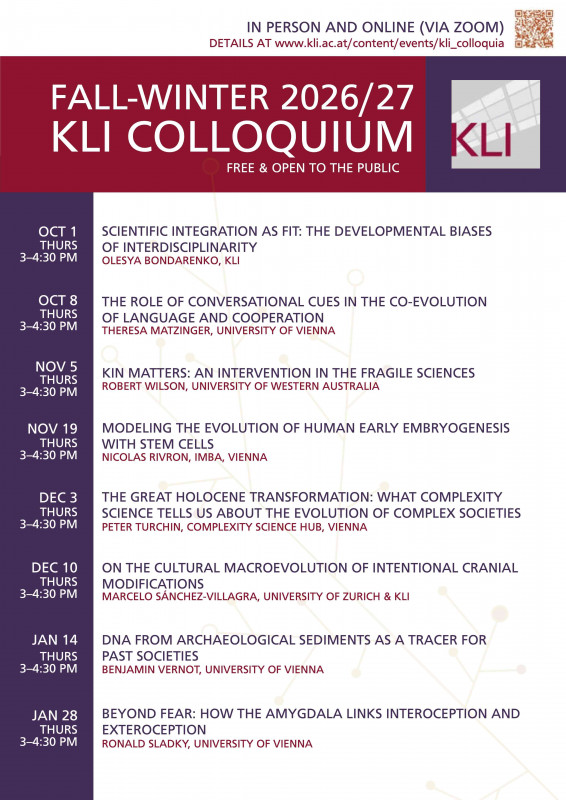
Scientific Integration as Fit: The Developmental Biases of Interdisciplinarity
Olesya BONDARENKO (KLI)
8 October 2026 (Thurs) 3-4:30 PM CET
The Role of Conversational Cues in the Co-Evolution of Language and Cooperation
Theresa MATZINGER (University of Vienna)
5 November 2026 (Thurs) 3-4:30 PM CET
Kin Matters: An Intervention in the Fragile Sciences
Robert A. WILSON (University of Western Australia)
19 November 2026 (Thurs) 3-4:30 PM CET
Modeling the Evolution of Human Early Embryogenesis with Stem Cells
Nicolas RIVRON (Institute of Molecular Biotechnology/IMBA, Vienna)
3 December 2026 (Thurs) 3-4:30 PM CET
Peter TURCHIN (Complexity Science Hub, Vienna)
10 December 2026 (Thurs) 3-4:30 PM CET
On the Cultural Macroevolution of Intentional Cranial Modifications
Marcelo SÁNCHEZ-VILLAGRA (University of Zurich)
14 January 2027 (Thurs) 3-4:30 PM CET
DNA from Archaeological Sediments as a Tracer for Past Societies
Benjamin VERNOT (University of Vienna)
28 January 2027 (Thurs) 3-4:30 PM CET
Beyond Fear: How the Amygdala Links Interoception and Exteroception
Ronald SLADKY (University of Vienna)
KLI Colloquia 2014 – 2026
Event Details
Topic description / abstract:
In this talk, I argue for the need of a new concept of environment for human health studies. After showing the theoretical shortcomings of the fashionable concept of exposome, I borrow from studies in philosophy of biology the idea that the biological environment is a constructed niche. In this view, the environment is always determined (at least partly) by the properties and activities of its reference entity (ontological dependence). Besides, it includes elements that depend on the problem addressed by scientists (epistemological dependence). I claim that, to be more relevant and operational, the environment in health studies should be conceived as a pathogenic niche, epistemologically shaped by the physicians' questions, and ontologically determined by the population that inhabits it. Finally, I ask how our proposal could be translated into tools for scientific practice, and I show its empowering nature for physicians, scientists, but also for politicians and lay people.
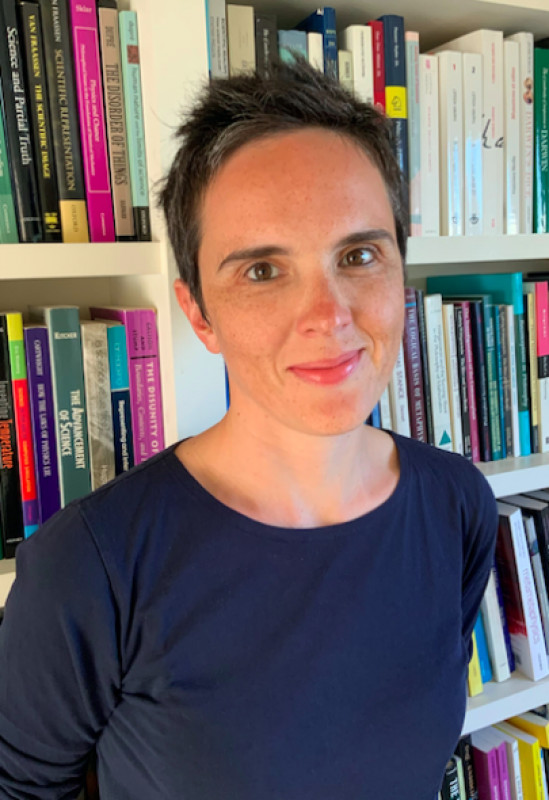
Biographical note:
Francesca Merlin: Permanent research fellow in philosophy of science at CNRS and Director of the IHPST lab, Francesca Merlin holds a PhD in Philosophy (University of Paris 1 Panthéon Sorbonne, 2009). Her research focuses on central concepts in biology such as chance and probability, inheritance and reproduction, epigenetics both from the developmental and the evolutionary point of view. More recently, she has launched a research project on the plurality of ways in which the environment is conceived and operationalized in the study of environmentally induced diseases throughout biomedical and social sciences. Since 2018, she is President of the Société de Philosophie des Sciences (SPS). In 2019, she received the CNRS Bronze Medal.
