

KLI Colloquia are invited research talks of about an hour followed by 30 min discussion. The talks are held in English, open to the public, and offered in hybrid format.
Join via Zoom:
https://us02web.zoom.us/j/5881861923?omn=85945744831
Meeting ID: 588 186 1923
Fall-Winter 2026/27 KLI Colloquium Series
1 October 2026 (Thurs) 3-4:30 PM CET 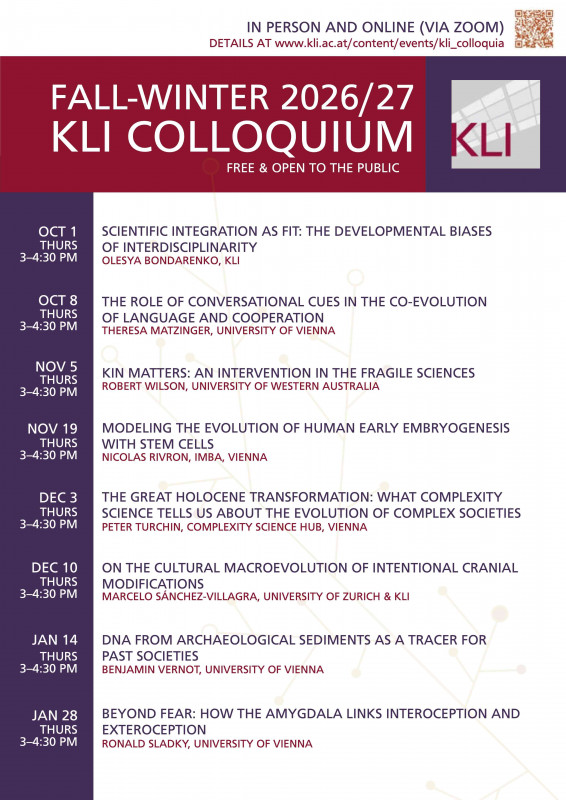
Scientific Integration as Fit: The Developmental Biases of Interdisciplinarity
Olesya BONDARENKO (KLI)
8 October 2026 (Thurs) 3-4:30 PM CET
The Role of Conversational Cues in the Co-Evolution of Language and Cooperation
Theresa MATZINGER (University of Vienna)
5 November 2026 (Thurs) 3-4:30 PM CET
Kin Matters: An Intervention in the Fragile Sciences
Robert A. WILSON (University of Western Australia)
19 November 2026 (Thurs) 3-4:30 PM CET
Modeling the Evolution of Human Early Embryogenesis with Stem Cells
Nicolas RIVRON (Institute of Molecular Biotechnology/IMBA, Vienna)
3 December 2026 (Thurs) 3-4:30 PM CET
Peter TURCHIN (Complexity Science Hub, Vienna)
10 December 2026 (Thurs) 3-4:30 PM CET
On the Cultural Macroevolution of Intentional Cranial Modifications
Marcelo SÁNCHEZ-VILLAGRA (University of Zurich)
14 January 2027 (Thurs) 3-4:30 PM CET
DNA from Archaeological Sediments as a Tracer for Past Societies
Benjamin VERNOT (University of Vienna)
28 January 2027 (Thurs) 3-4:30 PM CET
Beyond Fear: How the Amygdala Links Interoception and Exteroception
Ronald SLADKY (University of Vienna)
KLI Colloquia 2014 – 2026
Event Details

To join the KLI Colloquia via Zoom:
https://us02web.zoom.us/j/86548837670?pwd=AWm1v389npLyoJD5e01a9rjMXD7FP6.1
Meeting ID: 865 4883 7670
Passcode: 342640
Topic description / abstract:
Childbirth is a relatively long and risky process in humans, especially compared to most other primates. This is a direct consequence of the fact that human fetuses—particularly their heads—are large in comparison to the small maternal birth canal. The outcomes of birth can be devastating for both mother and child. Each year, more than 300,000 women worldwide die due to complications during pregnancy and childbirth. In the poorest parts of the world, the lifetime risk of maternal death remains as high as 1 in 6.
Why did evolution not produce a more spacious birth canal in humans to mitigate the high mortality associated with childbirth? In this talk, I will address this question and explain why evolution has not arrived at a better solution to the challenge posed by the tight fit during birth. By integrating perspectives from anthropology, evolutionary biology, and medicine, I will analyze the selective pressures that have shaped the evolution of the human pelvis and childbirth.
Biographical note:
Dr. Barbara Fischer is an evolutionary biologist with a background in mathematics. Her research focuses on the evolution of human anatomy, particularly the complexities of human birth. She is currently a group leader in evolutionary biology at the Konrad Lorenz Institute for Evolution and Cognition Research and is also affiliated with the University of Vienna. Dr. Fischer earned her PhD in Ecology and Evolution from the University of Berne, Switzerland, and has conducted research in Norway and Finland. She is passionate about science communication and is the author of a high school biology textbook.
